Bomber Traverse
Published:
History
On November 15, 1957, a Boeing TB-29 Superfortress was returning to Elmendorf Air Force Base just north of Anchorage after a radar-calibration mission. The weather had deteriorated badly, and the crew was flying through clouds and snow in the Susitna Valley.
They were about 27 miles off course without realizing they had entered the Talkeetna Mountains. At about 6:22 p.m., the aircraft struck an unnamed glacier at roughly 5,600 feet. There were 10 men aboard. Six died in the crash, including the pilot and several officers. Four survived and were eventually found and rescued from the glacier by helicopter.
Nearly seven decades later, the remnants of the crash are still visible and have become the namesake of Bomber Glacier. For those who enjoy the sport of walking, the Bomber Traverse is a 20-mile loop that circumnavigates the glacier.
Context
My fiancée, Mary, is working as a public defender in Palmer, Alaska, this summer. I came out to visit for her final two weeks in Alaska. On Friday, August 21, I caught an Uber from my office in San Carlos, California, to SFO and flew directly to Anchorage, where Mary was generous enough to pick me up at around 11 p.m. We drove back to her apartment in Palmer, where we found one Gus Robinson asleep. Gus graduated in June and was enjoying a summer of adventure before starting a big-boy job in San Francisco at the end of August.
Before flying to Alaska, Mary, Gus, and I had made loose plans to hike the Bomber Traverse in three days. However, we decided to make the final go/no-go call once we were all in Alaska and the weather forecast was more certain.
So, on Saturday morning, we woke up, looked at the forecast, ate some scrambled eggs prepared by Gus, and decided to go for it. We would hike in from the Gold Mint Trailhead, stay one night at Mint Hut, and then continue counterclockwise around the traverse, exiting at the Reed Lakes Trailhead. We made the following packing decisions:
- We carried one tent in case the huts proved to be crowded or smelly for our liking.
- Between the three of us, we carried two pairs of microspikes and one pair of aluminum crampons.
- We carried two bear cans, which, given the huts along the route, were probably unnecessary. At least we would sleep soundly knowing that our food was protected from any critters by rigid plastic and double-locking lids.
Our first stop on the way out of town was a local burrito spot; however, we timed our visit to arrive shortly after a girls’ softball team and therefore decided to go to Plan B: Taco Bell. Taco Bell the restaurant turned out to be closed, but Taco Bell the drive-through was open. Gus and I each purchased two chicken burritos, and Mary got a Melt.
Our second stop was the NOLS used-gear sale. The NOLS Alaska program is based in Palmer, and it happened to be holding a used-gear sale that Mary had heard about. We purchased one pair of rain pants (Gus had not packed his) and two mismatched rain boots for the grand total of $0.
Trailhead -> Mint
We started our walk under cloudy but dry skies at 11 a.m.
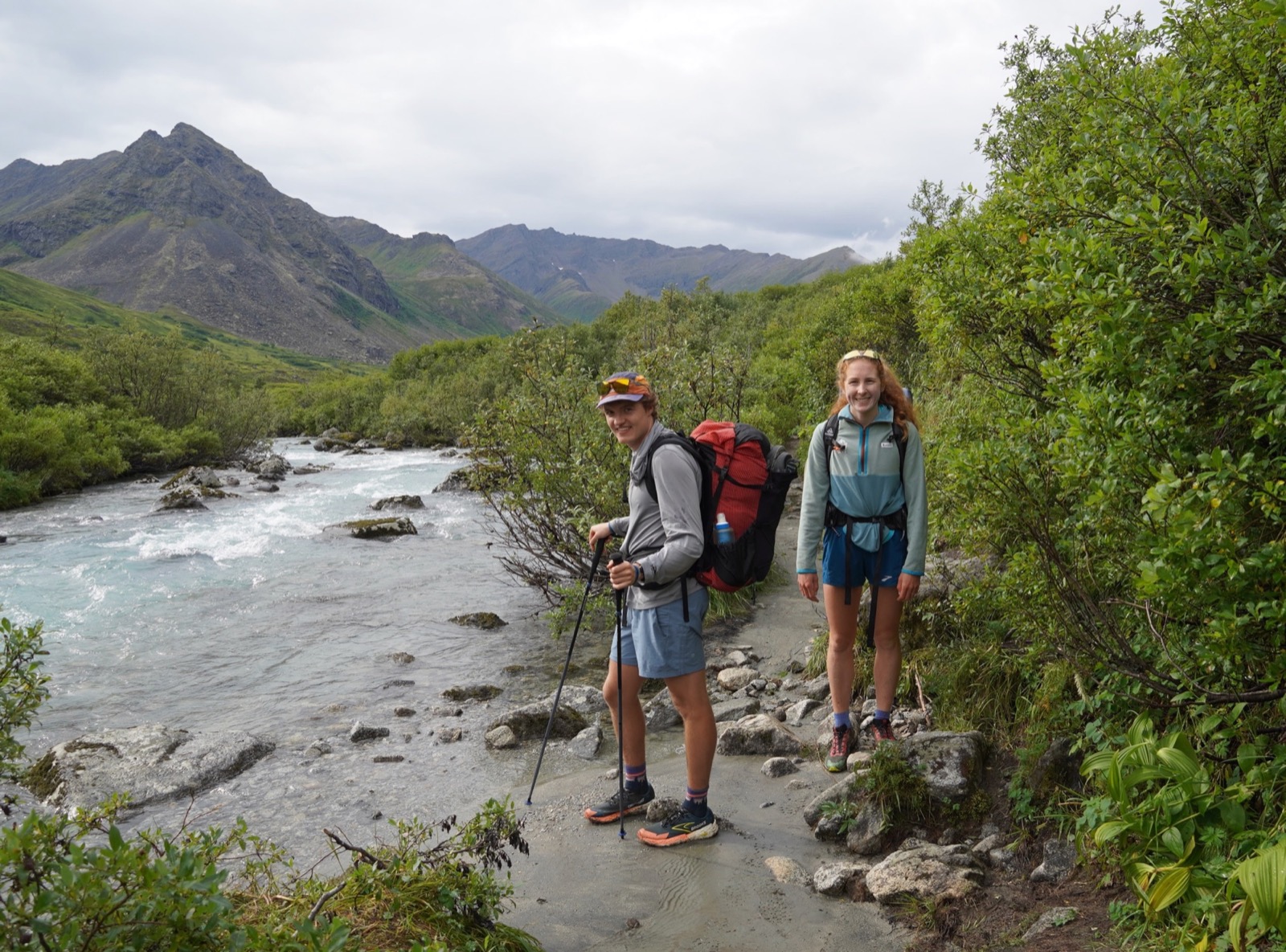 Mary and Gus along the Little Susitna River.
The trail up the valley was in reasonably good condition except for the spots where beavers had dammed the creek, causing the trail to flood.
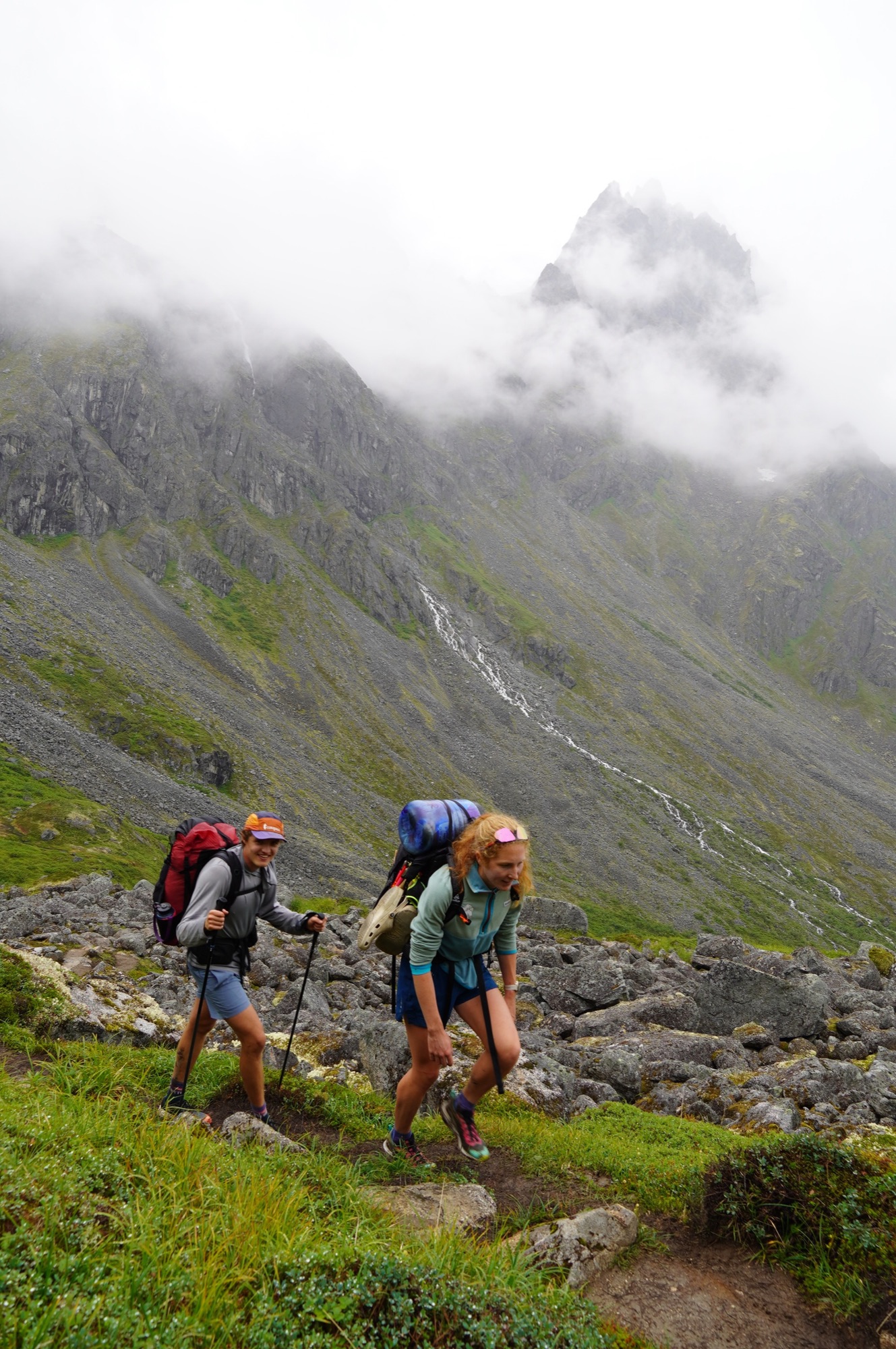 We walked up the valley before cutting left toward a local promontory point.
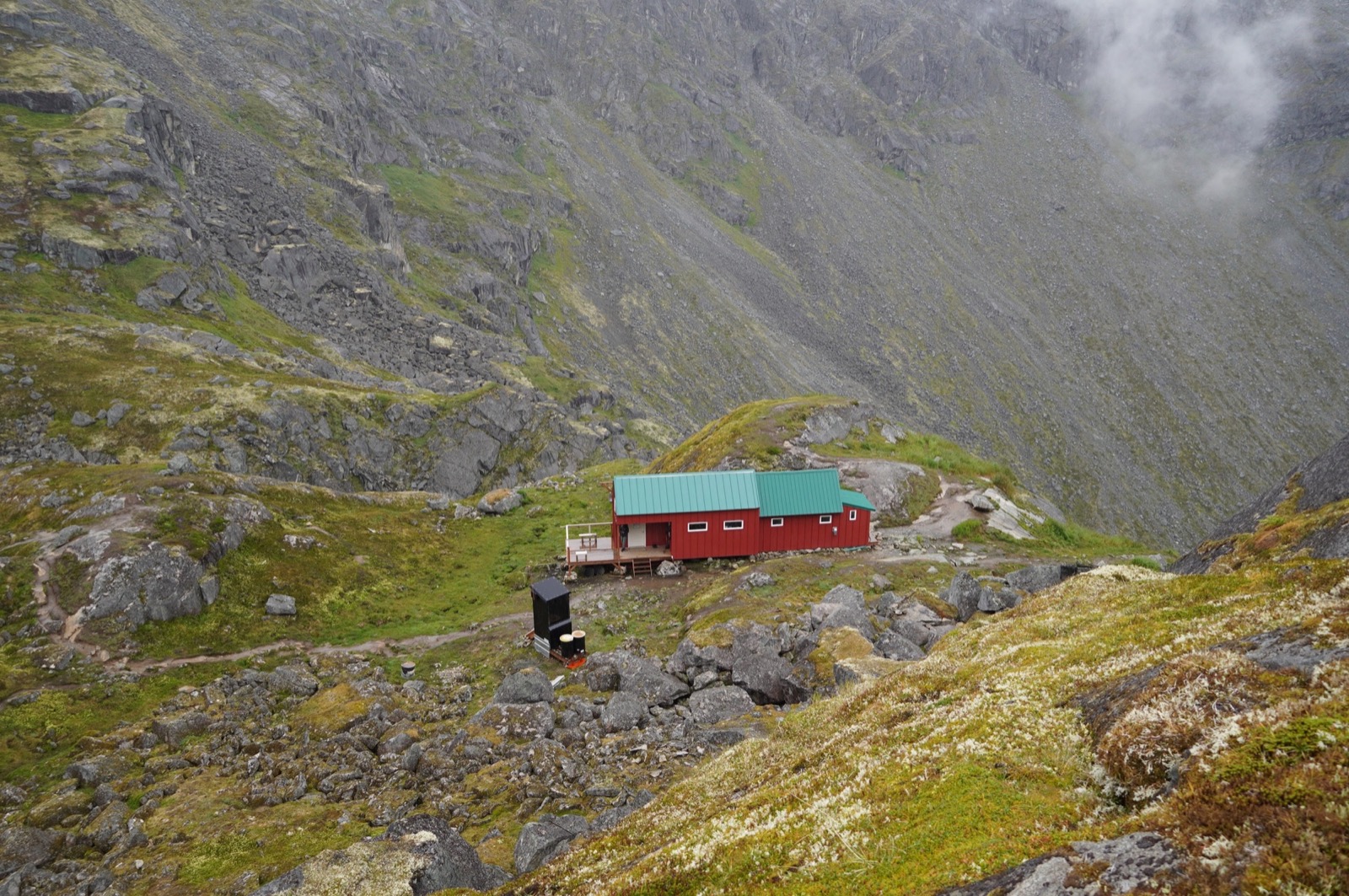 Dropping down towards Mint Hut.
At the hut, we were greeted by a friendly group of four girls from Bend, Oregon, who were doing our route in reverse over four days. In addition to staying at Mint and Snowbird, they also spent a night at Bomber, which we planned to skip entirely. The lead stoker of their group was a big whitewater kayaker, so she and Gus chatted about boating while we made quesadillas with the Jetboil. We also learned that one of their group members was a graduate of Fort Lewis in Durango (Go Skyhawks!) and still worked in the outdoor education program there despite residing in Bend.
With rainy skies, the hut was a bit chilly, so we retreated to our sleeping bags. Mary and Gus read while I passed out for about two hours.
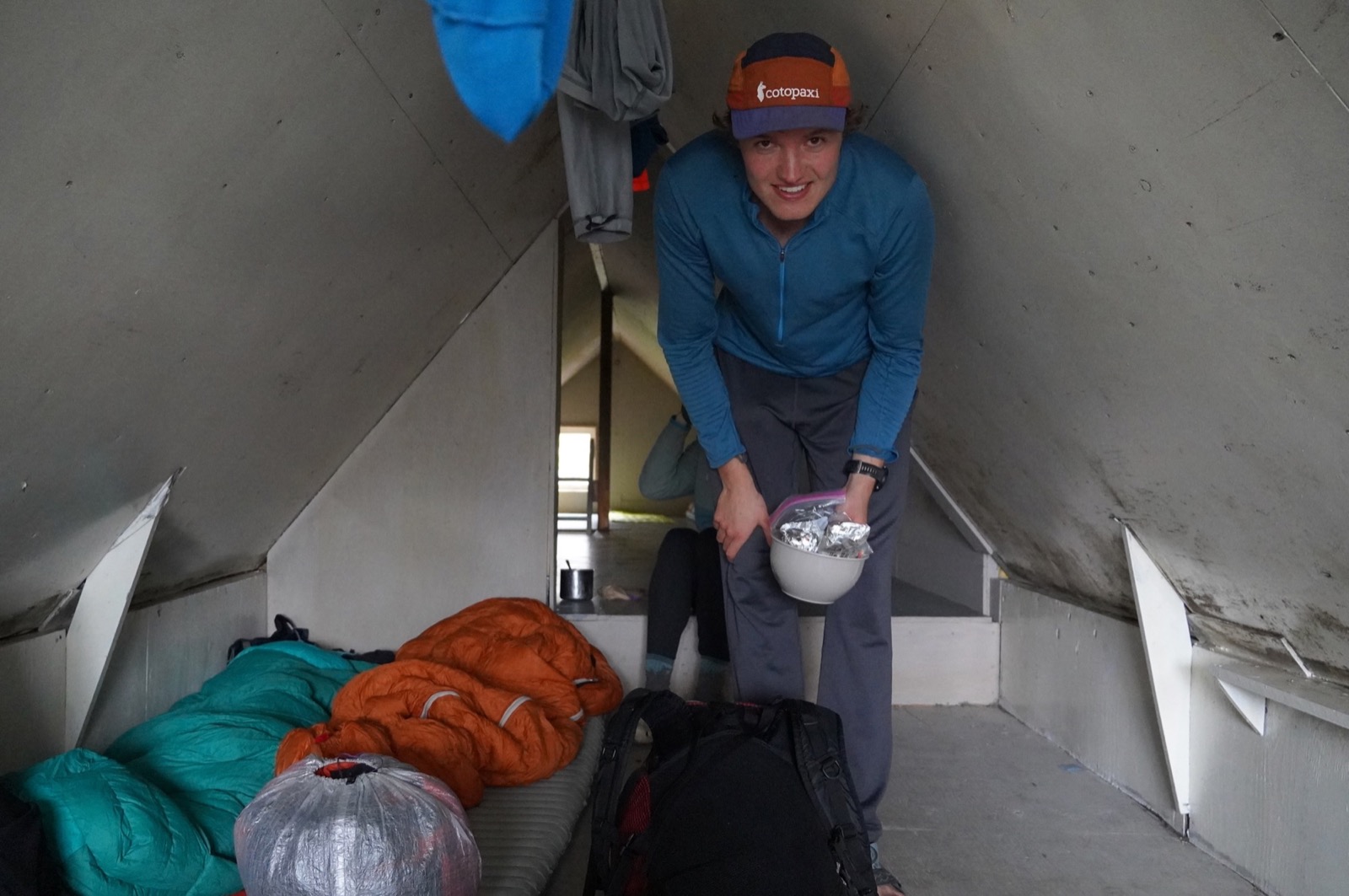 Cozy sleeping quarters.
And then it was dinnertime! The overall review of Taco Bell dinner burritos is three stars: perfectly adequate but uninspired.
While we were eating, two girls from Soldotna arrived. One was a lawyer in Anchorage and the other a masseuse in Wasilla. They carried an ultralight stove setup with a small titanium pot and PocketRocket. However, whatever grams they saved with that setup were lost to the boxed wine and small dog they had also brought.
We learned about working as a prosecutor in Anchorage and also talked about Dungeon Crawler Carl, a series that about half the hut (Gus, two of the girls from Bend, and the younger sister from Soldotna) was reading.
There were no big snorers in the group, and we all slept well. The noisiest part of the night was Gus and me squeaking on our Therm-a-Rest X-Therm and X-Light inflatable pads.
Mint -> Snowbird
The next morning dawned clear. Walking outside the hut, we were able to get a good look at the valley we had come from the day before. After a quick breakfast of oats (a classic 200 g per person) and use of the outhouse (we donated to the Alaska Alpine Club to support the poop-bin removals), we were on the move.
The scramble up to Backdoor Gap was pretty straightforward. The day was clear enough to have a nice view of Denali!
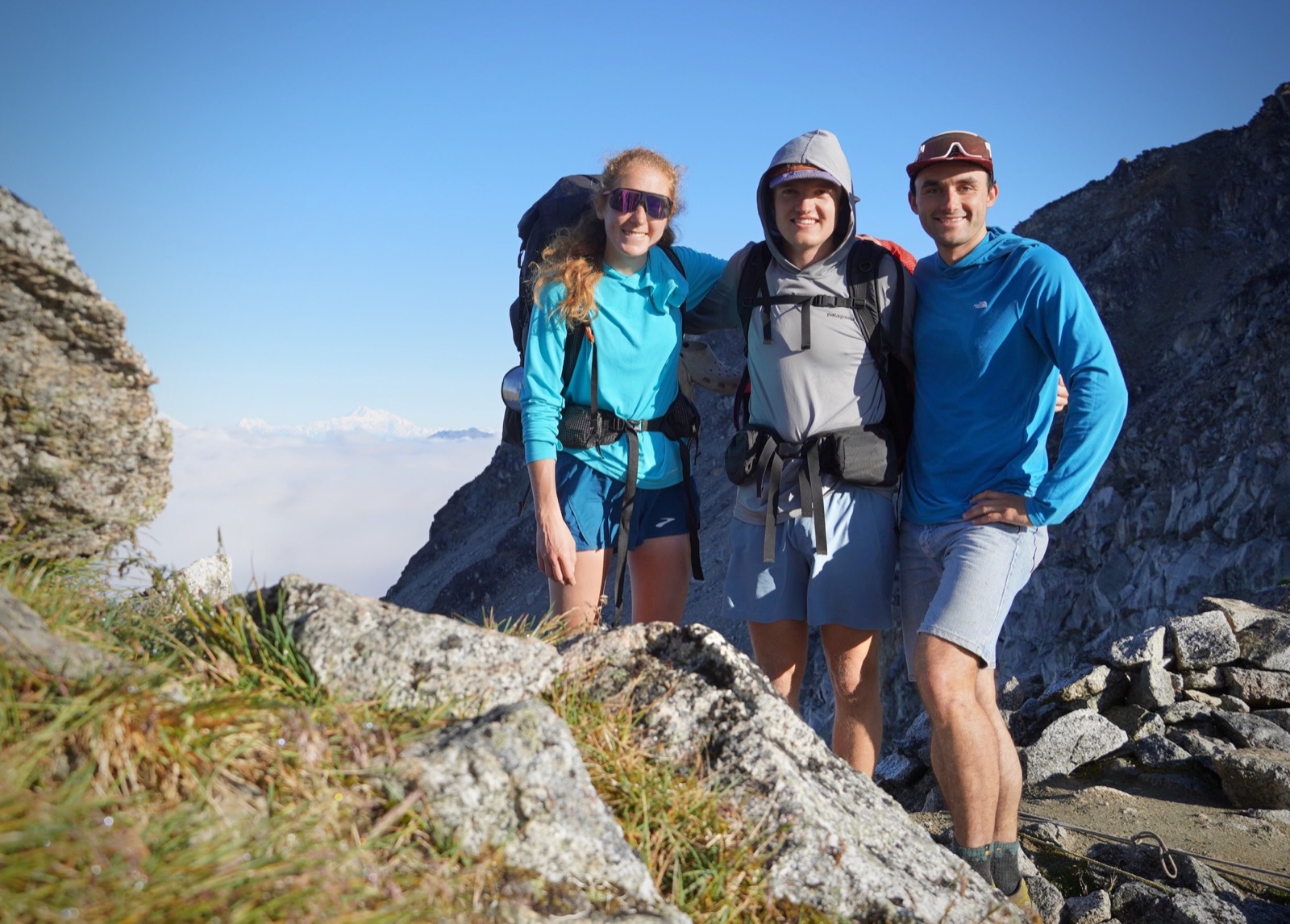 Denali peeks out behind us while we pose for the self-timer.
From the gap, we used a fixed rope to descend onto the gentle glacier. Gus and I put on our microspikes, but Mary didn’t bother.
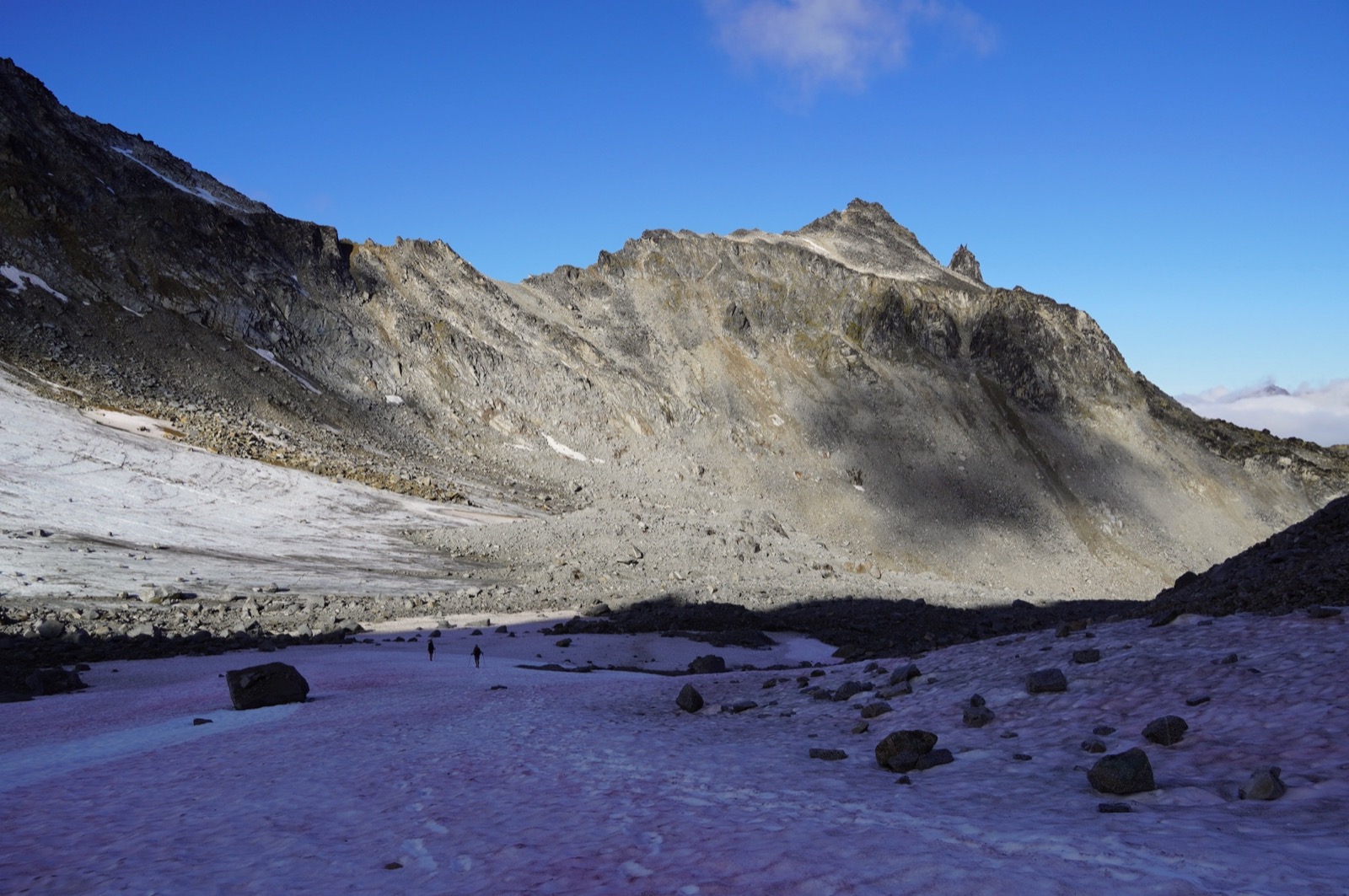 Easy walking.
We ate lunch at Bomber Hut, which is the smallest of the three. It certainly had plenty of space for our group but would have become crowded if a second group had arrived.
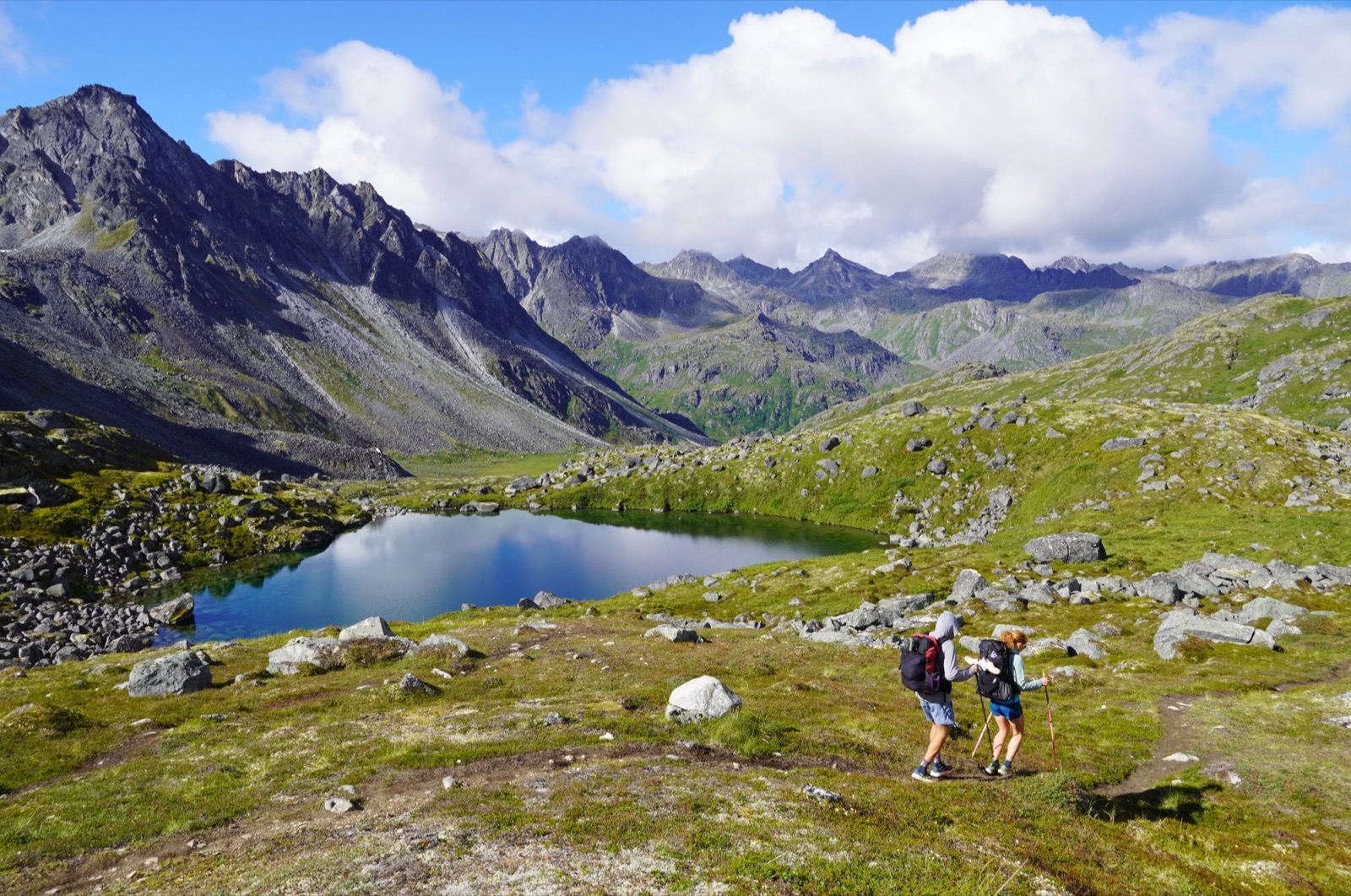 Departing Bomber.
From Bomber, we continued down the valley on mostly good trails until we arrived at the creek flowing down from Snowbird Glacier and turned left to walk up it. The crux of the climb to Snowbird was likely scrambling up Snowbird Creek to gain the ridge adjacent to Snowbird Glacier, where the hut was built. Gus took an easier, lower line, but Mary’s line was a better photo opportunity.
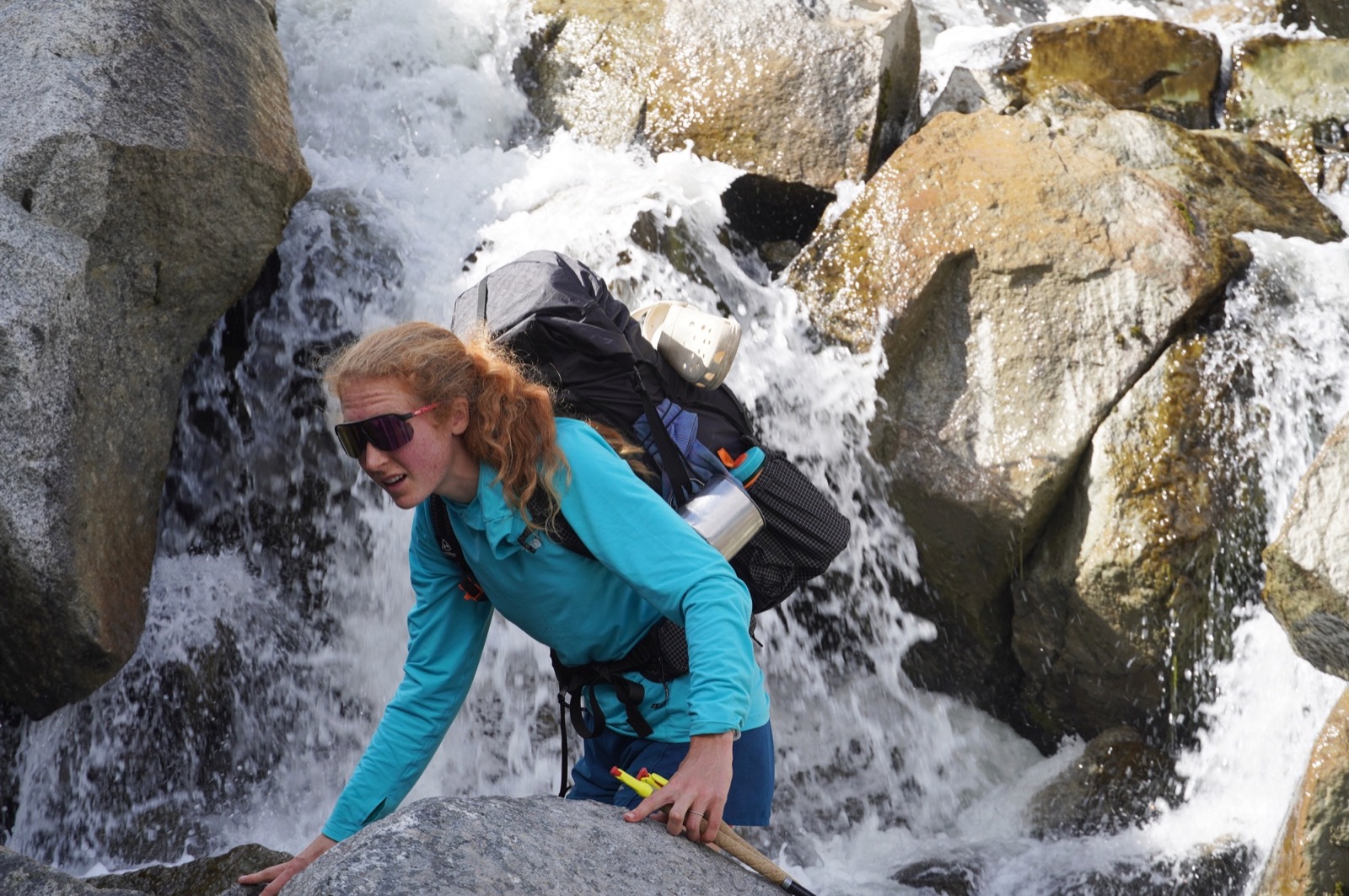 The photo opportunity.
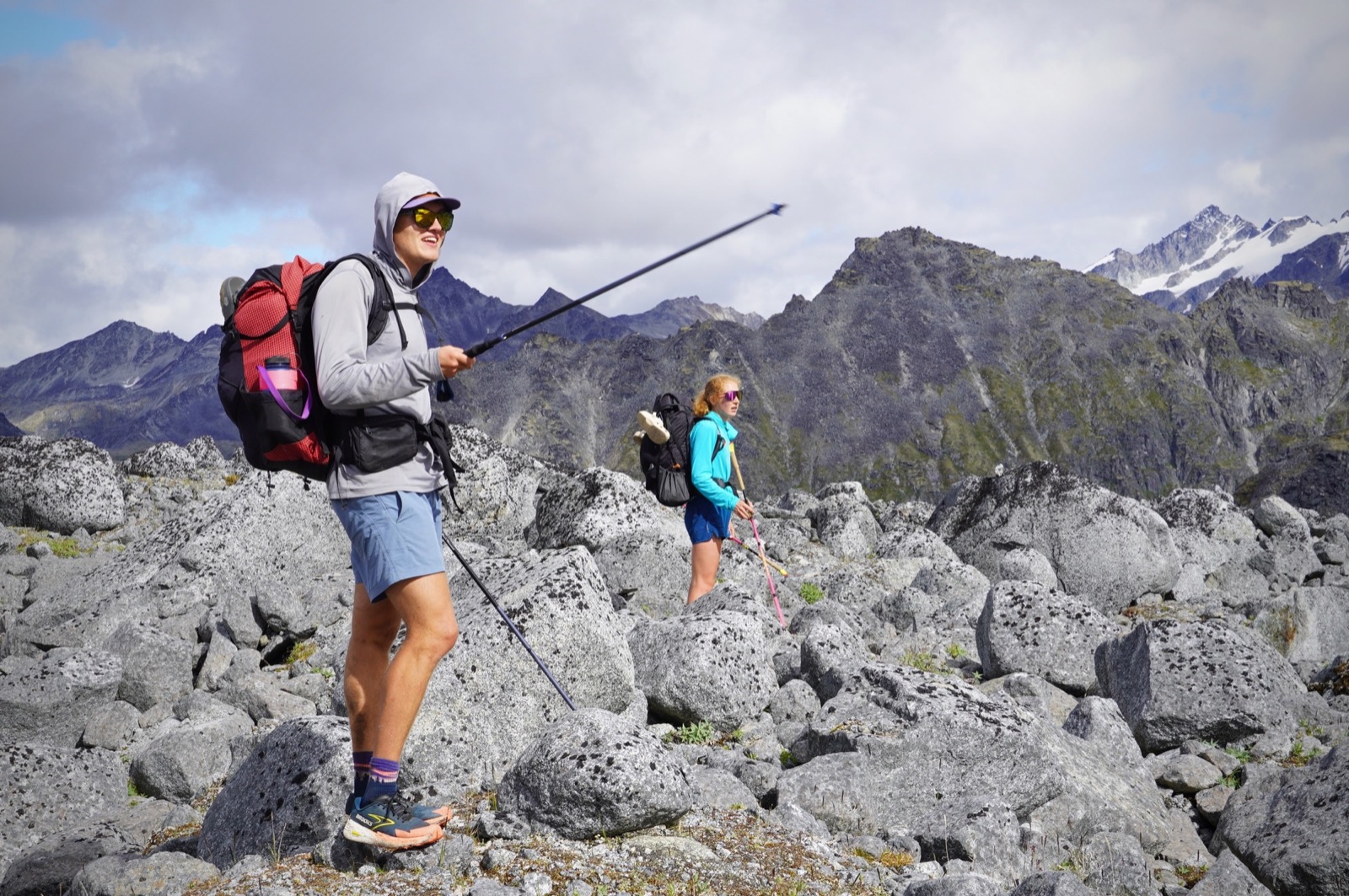 Gus and Mary exhibit their classic adventure expressions.
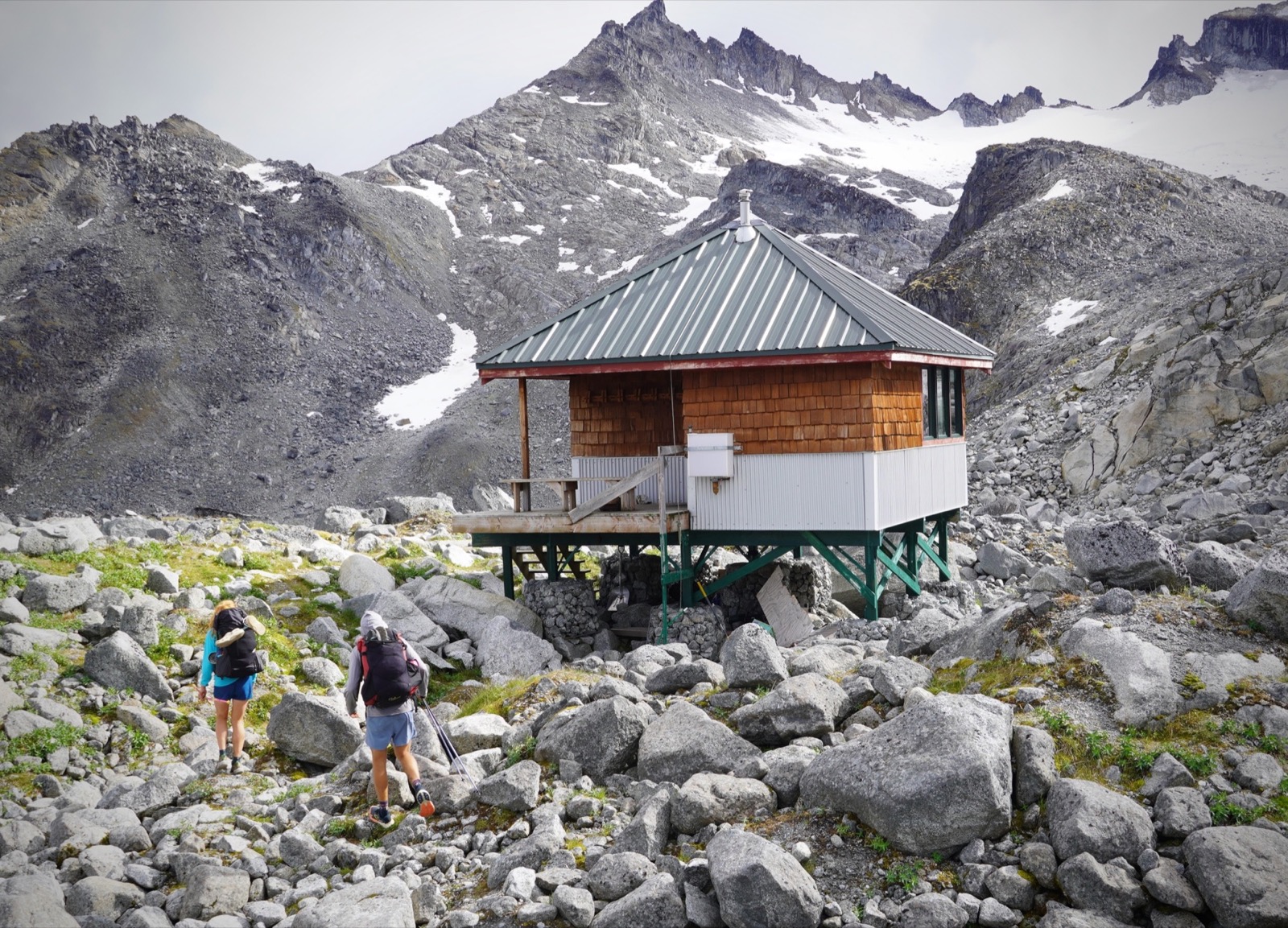 Snowbird hut is a stunner.
The most that can be said against the hut is that it was built for snow recreation, and as a result, there is no water nearby. After we arrived, Mary and I walked down to the glacier to fill all our water vessels and a pot.
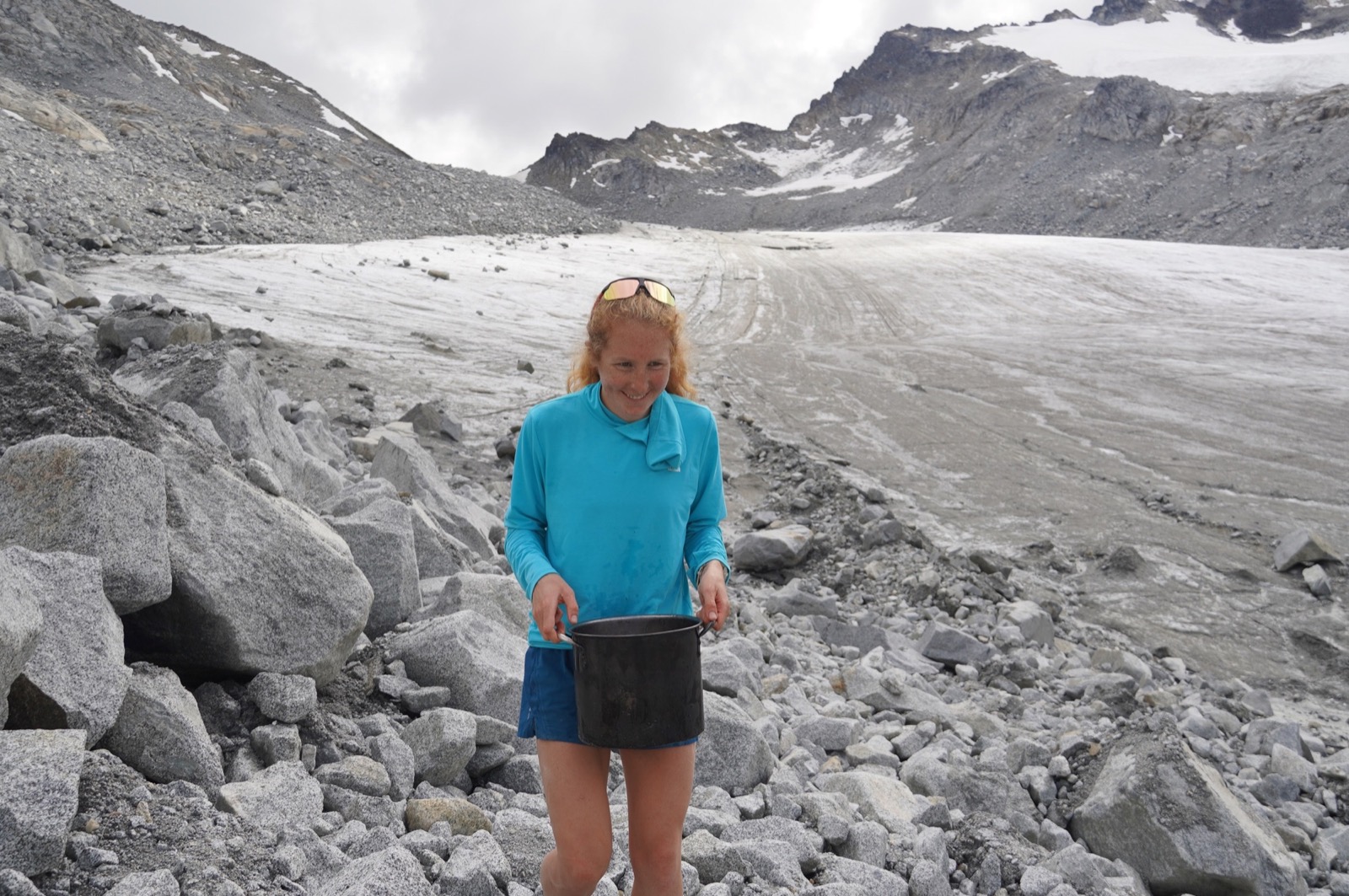 Mary’s upper-body workout for the day.
The hut overlooks Snowbird Glacier, and we had a pleasant afternoon reading old trip logs that tell amusing tales of nearby hot springs (probably a joke?) and playing chess on the mini chessboard in the hut (Paxton 2, Mary 1).
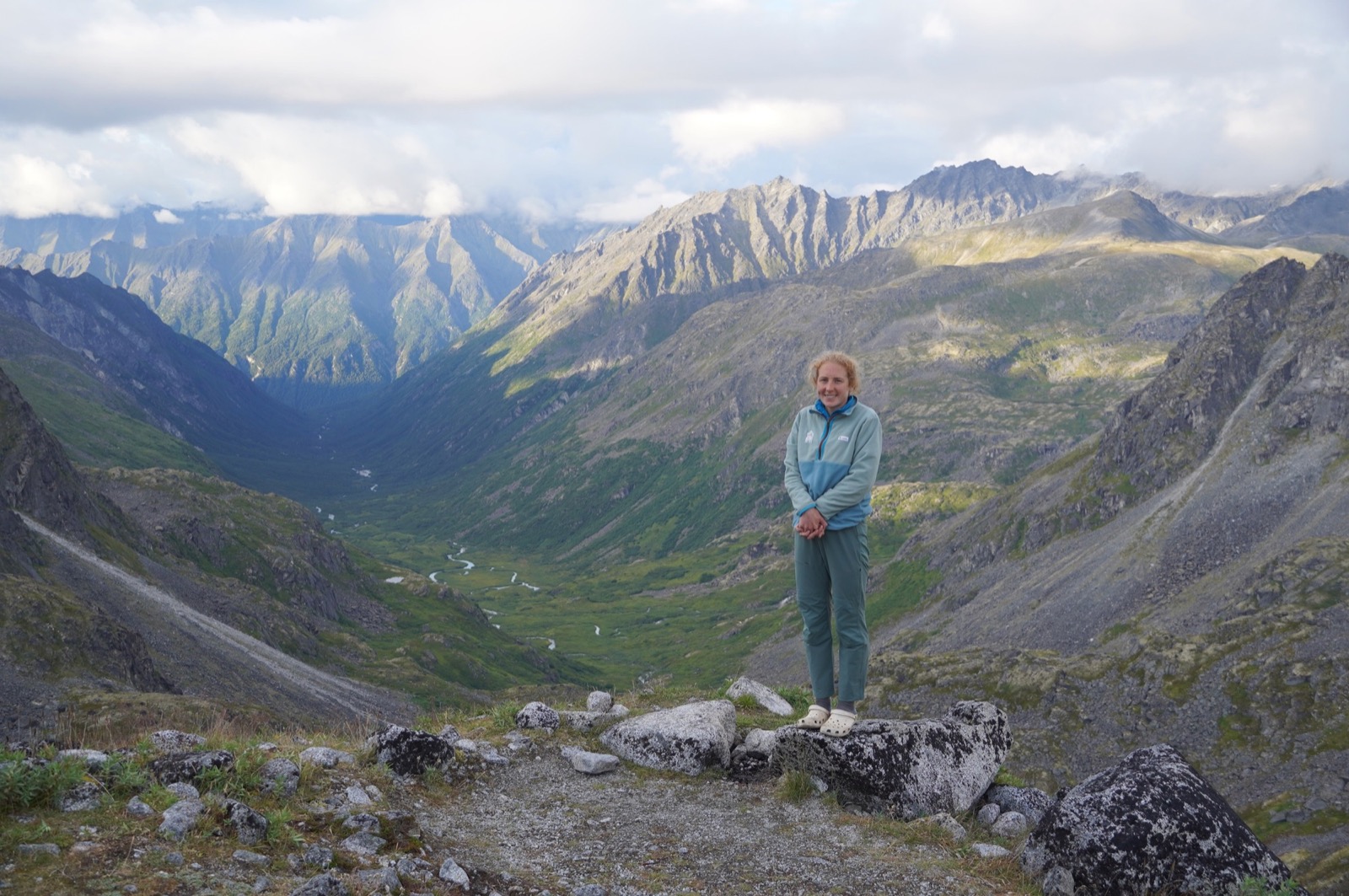 Looking back down the valley we walked up.
As we were cooking dinner, two ladies arrived who had walked from the Reed Lakes Trailhead. One was from Anchorage, while the other lived in Colorado, but they had originally met while working at a research station in Greenland. Despite seemingly having plenty of material, my attempts to get a conversation going were largely unsuccessful. The best start was a discussion of Endurance (I had the paperback with me), but after talk of Elephant Island grew stale the ladies returned to their card game, and Gus, Mary, and I returned to our own conversation.
Two other folks arrived late, around 9 p.m. Mary was already asleep, but I learned that the new couple had both gone to school at Davis and were working in Talkeetna for the summer–the guy as a hiking guide and the woman in a coffee shop. They were both climbers and had spent much of the previous year in Truckee! Small world. After chatting for a moment, they went to cook dinner outside to, I assume, avoid waking our sleeping companions. Very polite!
Snowbird -> Out
In the morning, I used the outhouse, which claimed to be of a revolutionary design (at least as of 2002) that does not require poop barrels. The sign on the outhouse door also requested that each user donate $2 to help cover the helicopter lift for the waste at the end of the season.
We made oats and departed the hut before the other groups woke up. The weather was cloudier than the day before but still much nicer than I had expected to see in Alaska in late August.
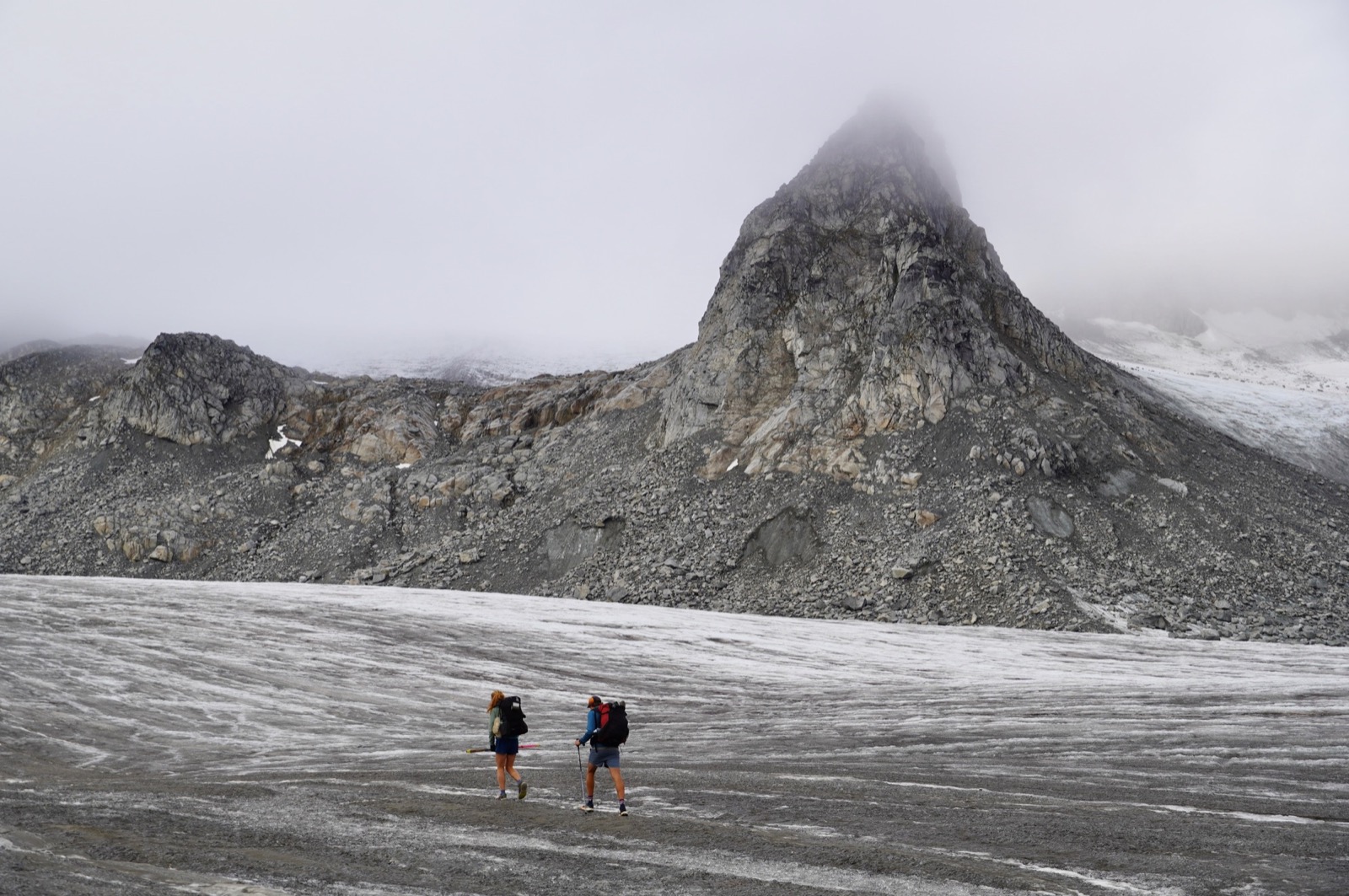 Cloudy day.
The walk up the glacier was chill, the pass was chill, and the descent from the pass was on a very good trail. We made it back to the Reed Lakes Trailhead in about three hours and then had another hour of dirt-road walking back to the car.
A very successful trip!
Notes
- Should have packed more cheese.
- Given that we never used our tent, it would have been nicer to carry a lighter alternative to the four-season, seven-pound Norwegian behemoth I ended up lugging. But that was the only tent we had with us in Alaska, and we didn’t feel bold enough to go without one.
- Consider carrying an empty water bladder to have a better vessel to haul water to the Snowbird Hut than a pot.
Leave a Comment
Your email address will not be published. Required fields are marked *