Asulkan Ski Hut
Published:
Contents
- Context
- Avalanches
- Rogers Pass History
- Pre-trip
- Day 1: Ski in
- Day 2: Storm Day
- Day 3: Tree Triangle Day
- Day 4: More tree triangle
- Day 5: Asulkan Pass and ski out
- Notes
Context
After a second Bow Yoho traverse in the spring of 2025, I started researching other huts in the Canadian Rockies with the goal of finding a hut that Mary might enjoy during her spring break from law school in the last week of March.
Initially, I had high hopes for the two ACC ski week cabins, Kokanee Glacier Cabin and Fairy Meadow Hut. Both allow a single group to book the cabin for an entire week and the booking includes a round trip helicopter ride. A sizable fraction of the 2026 Bow Yoho crew put their names in the hat for the ACC ski week lottery and we waited until results were published in June. No dice. I emailed the ACC to inquire how many people had also applied for Fairy Meadows and Kokanee and got the following response:
For Fairy Meadow, we received a total of 656 entries for the full lottery. The week of March 21–28 had 145 entries, making it one of the more popular weeks. For Kokanee, we received 965 total entries, with 90 specifically for March 21–28.
The next idea was Asulkan Hut, an ACC hut off Rogers Pass. That hut is booked on a per person basis, up to 180 days in advance for ACC members. A nuance to the booking system is that once you book a single night you can extend for up to 4 additional nights. As a result, there is no guarantee that the night which is 181 days out is not already booked by a group staying the previous night.
Our strategy was to attempt to book our first night as Sunday, March 22nd. If we were unsuccessful we planned to continue trying to book a first night for the next three days. Surprisingly, Sam managed to get all 10 Asulkan hut spots on the very first attempt. Sam then called and extended the stay to Friday.
Avalanches
Leading up to the trip, the avalanche situation was looking spooky. There were two persistent weak layers from January. In early March, Parks Canada sent out a warning email.
Staff members have seen numerous size 4 avalanches come down over the past week - these slides are big enough to bury buildings, a railway car, or a 10 acre forest.
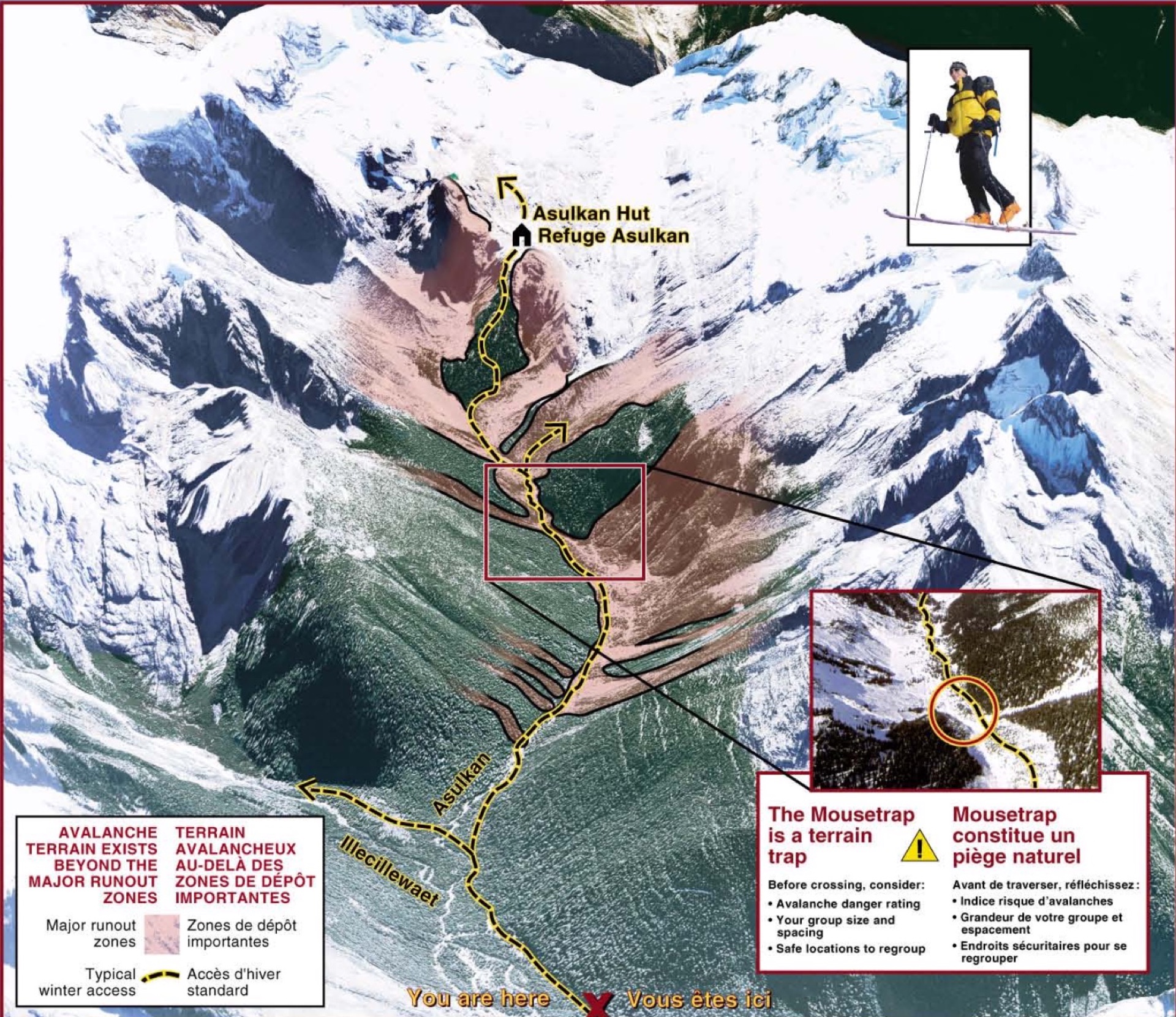 Avalanche terrain.
A week prior to our arrival a large warm storm moved in. The avalanche forecast predicted avalanche conditions increasing to “Extreme” at all elevations. Fortunately, the forecast predicted temperatures dropping on Saturday and staying low for the subsequent week. By the time we flew to Canada on Saturday, the forecast for Sunday was (3/2/2). And by Monday it was (2/2/1). A number of very large avalanches had run the previous week, but it appeared that the warm storm had largely solved the persistent slab problem.
Rogers Pass History
The first rail line was laid across Rogers Pass in 1885 as part of the Canadian Pacific Railway’s transcontinental line. The pass had only been ‘discovered’ four years earlier by its namesake A.B. Rogers. During the construction 6.4km of snowsheds were built to protect the train and workmen from avalanches. The CPR began regular coast-to-coast service in 1886. To avoid hauling dining cars, it was decided that there should be a permanent dining room on Rogers Pass.
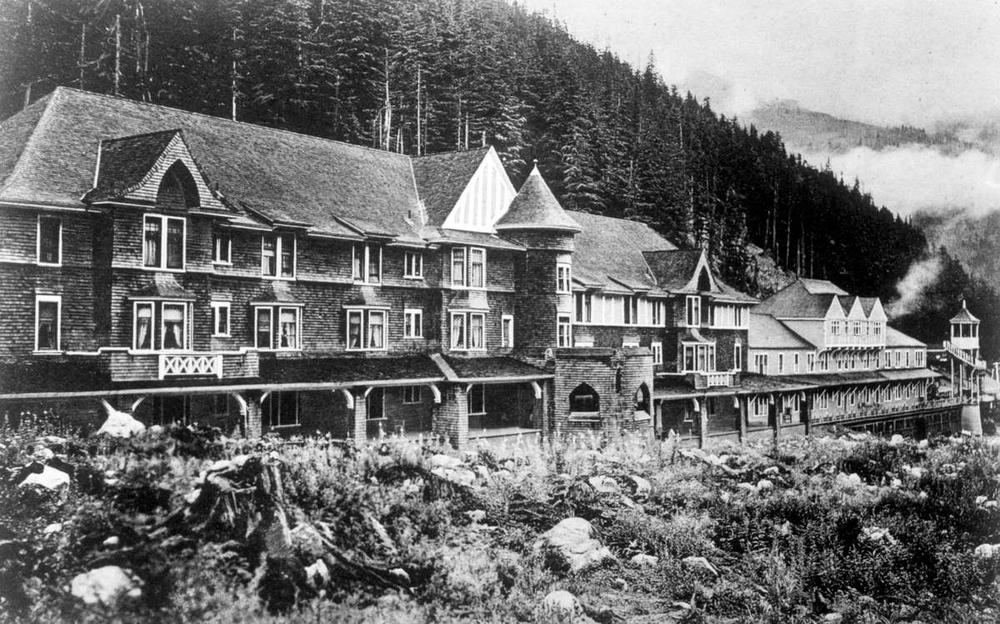 By 1895 the Glacier House had over 700 guests during the summer.
In 1899 CPR brought out two Swiss guides. The two guides returned to Interlaken that winter and six Swiss guides came to the Canadian Rockies the summer of 1900.
In 1906, A.O. Wheeler and Elizabeth Parker founded the Alpine Club of Canada.
In 1910, 58 railroad workers were killed in an avalanche on Rogers Pass while they worked to clear the tracks. The CPR admitted defeat and began building a tunnel under Rogers Pass. The five mile long Connaught Tunnel was completed in 1913.
The first Asulkan Hut was built in 1912 by the Alpine Club of Canada and was used as a base for peaks like Young’s Peak and Dome. The original hut was destroyed by an avalanche in 1925. A second hut was built shortly afterwards and then destroyed again by an avalanche in 1928. The modern day Asulkan hut was constructed in 1947 and was placed more carefully to reduce avalanche risk.
Pre-trip
Saturday afternoon, Mary, Catherine, and I pick up our Turo rental car at the Calgary airport and drive to Canmore. Our first stop is at the Canmore Save-On-Foods, to shop for ourselves and the other five flying in late that evening. Sam has clearly put some thought into his hut cuisine; his list includes items like 6oz pecorino romano, 16oz pancetta, and 12 eggs. Mary shops for Sam, Deirdre, Kyle, and Jazmine while I shop only for myself and Mary. Despite Sam’s variety of cheeses, she still beats me to checkout. Well played, Mary.
That evening, we call the rest of our group as they drive to Canmore in a second rental car and decide to postpone our ski-in by one day to Monday. While we feel reasonably safe skiing on Sunday (3/2/2, with the most significant risk being wind slab) it is agreed that it would be strictly safer to ski on Monday (2/2/1). The ancillary benefits of delaying a day include (a) a slow morning Sunday after a day of travel (b) Catherine is able to get more work done (c) the folks that flew in Saturday night have a bit more time to organize their bags.
On Sunday, Mary and I get out for a morning run along the trails around Canmore and our whole group goes for a soak in Radium Hotsprings, a Parks Canada operated natural spring about 2km from a town also named Radium Hotsprings. We stay Sunday night in a last-minute Airbnb outside Golden at Alpine Meadows Lodge B&B. Our unit is a four bedroom house for a little over 300 USD. In the evening, we eat one of the dinners Sam had planned to hike in with and go to bed with plans to depart at 7:30 the next morning.
Day 1: Ski in
The previous night we had decided that Thomas, Mary, and I would ski in together as part of the “slow” group. However, we happen to be the slightly faster group packing up and depart punctually at 7:30 while the other group is still loading their bags. We are not able to gloat about our timely departure for long. Shortly after crossing the one-way bridge across the Columbia we are stopped by a freight train sitting stationary on the tracks. After waiting about 10 minutes, our friends catch up and after 10 minutes more the train starts to move at a glacial rate. Eventually we are free to continue our journey.
After one more misadventure where I find myself driving the wrong way on the Trans-Canada Highway (I must say it was very poorly signed), we make it to the Rogers Pass trailhead, don our ski gear, weigh our packs (mine weighs in at 56 pounds), and begin skiing up the valley.
Enough fresh snow had fallen over the previous week’s crust that the conditions are pretty good. For the first couple of miles along the valley floor the biggest challenge is a skin track that follows the sloping bank of Asulkan Creek. While not especially exposed, I can tell that Mary does not love the fact that a careless step could result in a slide into the creek.
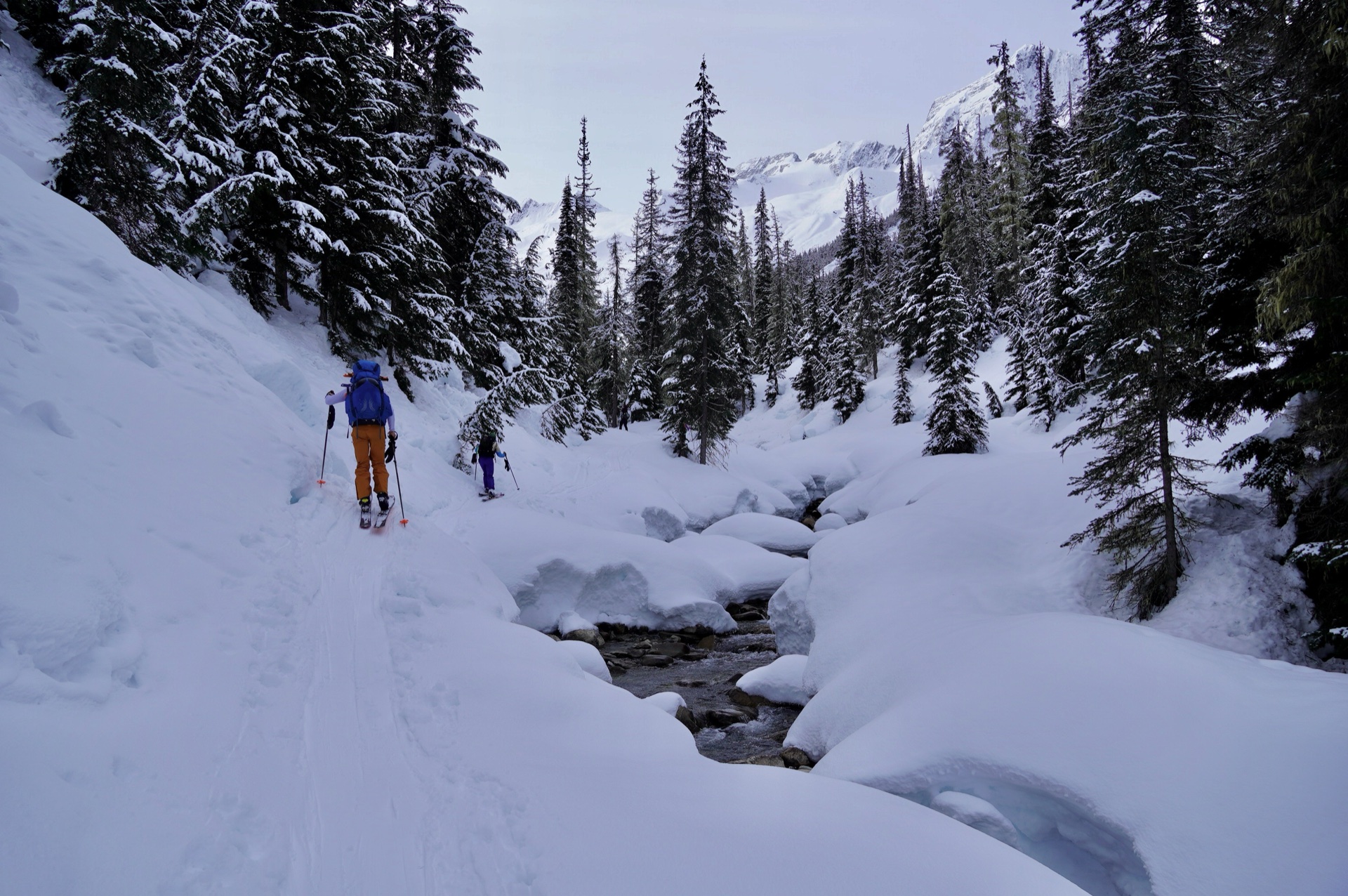 Thomas and Mary skin along Asulkan Creek.
We all make it through without wet feet and have another mile-ish of easy skinning before arriving at the Mousetrap, a portion of the valley known for intersecting avalanche paths. We are not especially worried about any avalanche today. However, some very large avalanches ran the previous week when a large wet storm saturated the snowpack. Now, the entire valley has uneven mounds of hard snow with broken trees poking out. About three inches of fresh snow has fallen on top of the avy debris, not quite enough to make it skiable.
After watching the group in front of us attempt to slowly circumnavigate the debris in the steep trees on climbers left, we decide to follow another young guy as he straps his skis to his pack, lowers himself into the debris field, and walks through the debris up valley.
I strap both Mary’s skis and mine to my pack. Fortunately, the debris is so hard packed it is mostly very easy to walk on. However, occasionally the new snow obscures a hole in the debris field that is not apparent until one’s boot sinks 10cm (notice the use of the local unit) more than anticipated.
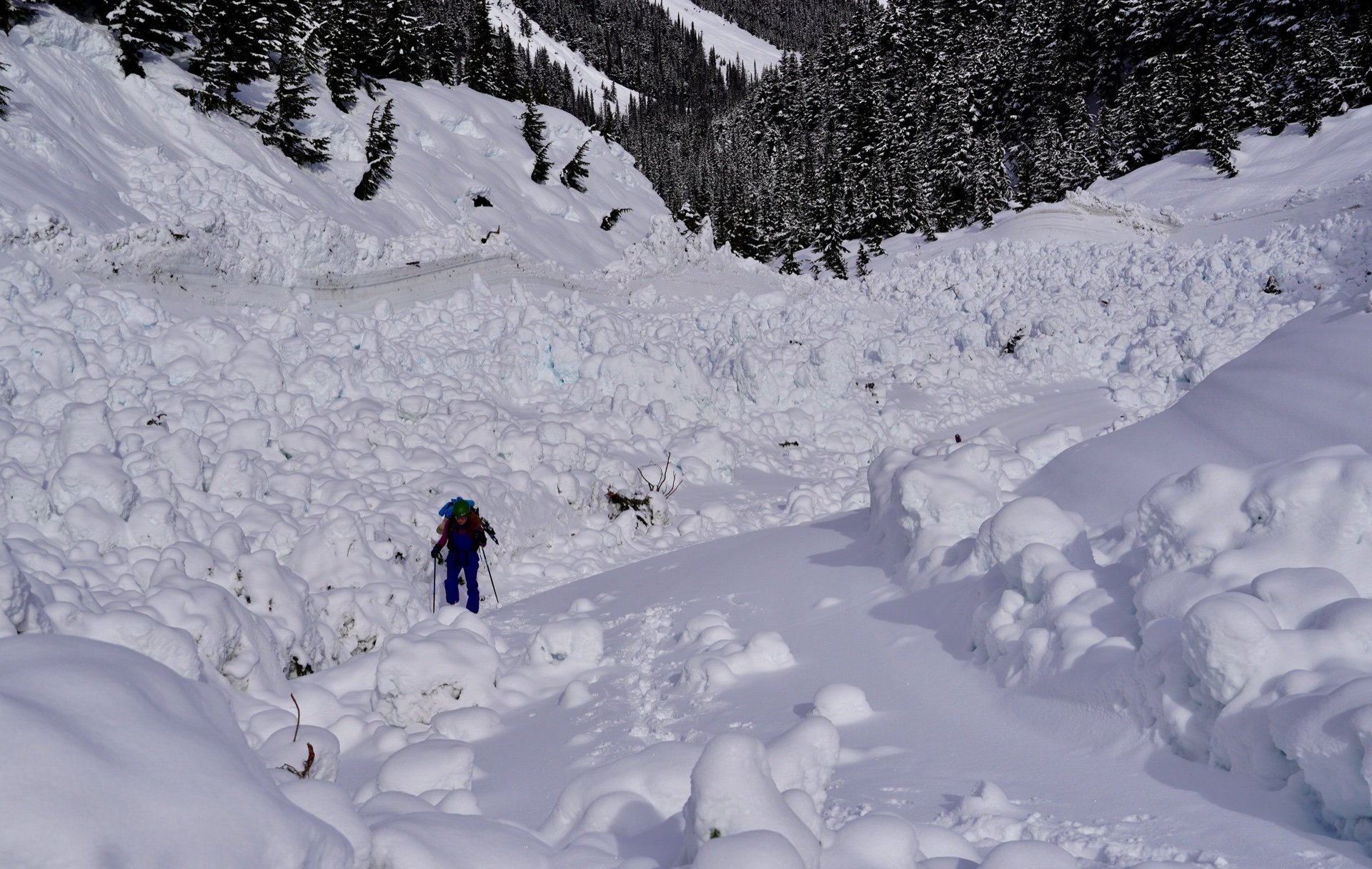 The debris field.
With two pairs of skis strapped to an already heavy backpack I am moving slowly and am stoked when we finally make it to the upper end of the debris and I am able to drop my load. While most of the group feels similarly, Mary cheerily volunteers that she enjoyed walking rather than being on skis and that the debris field walk was the easiest part of her day.
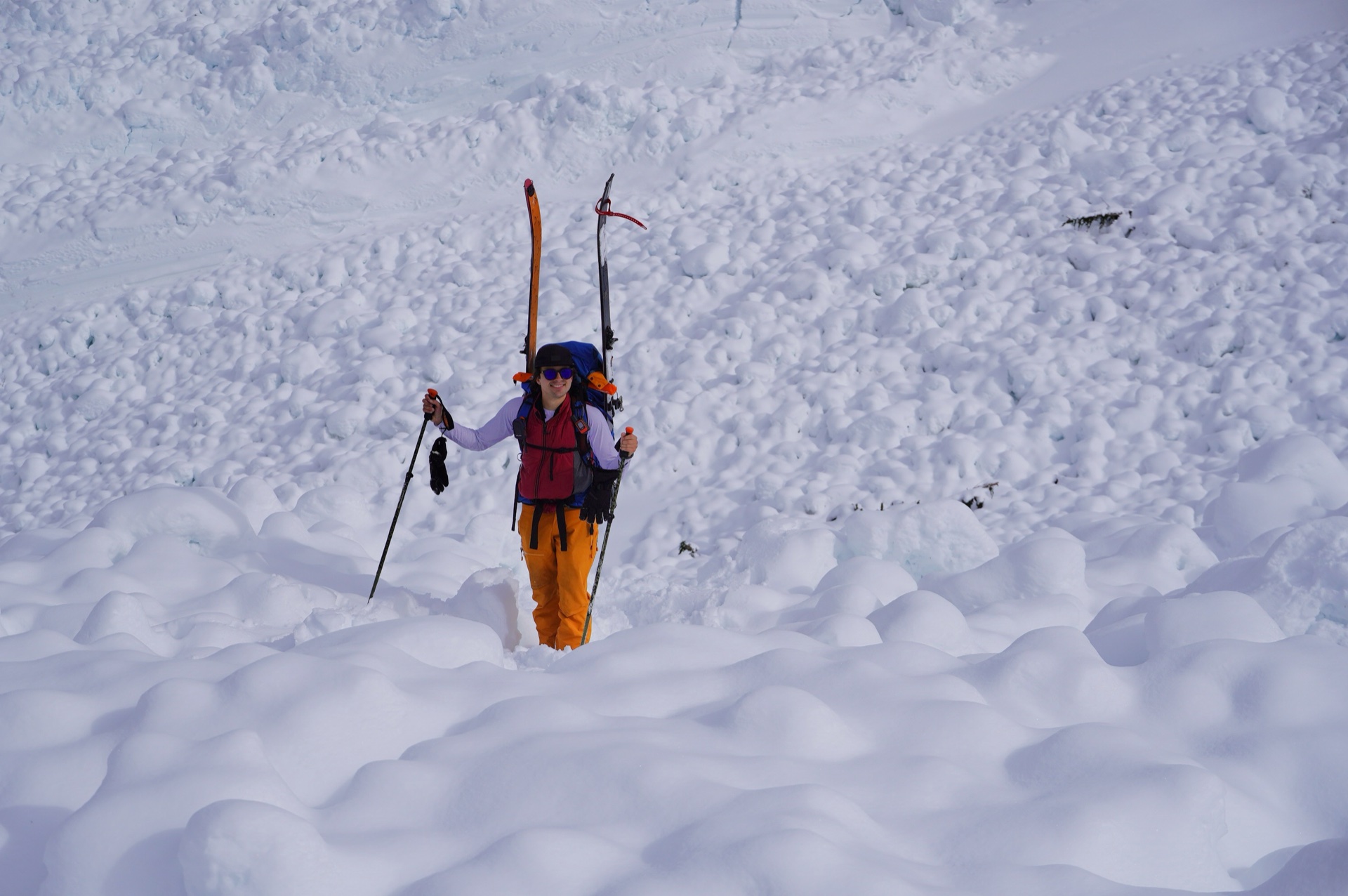 Thomas demonstrates superb style.
The good Canadian fellow who pioneered our boot packing approach is recuperating by smoking a joint. From here, we only have about 1 mile and 1500ft left. It turns out to be a challenging mile. There are two problems. First, Mary is still mastering the kick turn. She occasionally gets herself in the ∨ of death where both skis are spread sufficiently wide as to be inoperable and then feels very exposed and out of control. The second is that the skin track is somewhat steep in places, and Mary is also still mastering the art of a steep skin track. She occasionally leans too far forward, exerting her normal force parallel to the slope, and slides backwards.
Our low point comes when Mary is caught in the ∨ of death and I naively suggest she take her skis off to reposition herself. As soon as she takes one ski off she immediately post-holes up to her thigh. Not so fun. After a bit more faff, we decide to flip to snowshoes, which I am also carrying.
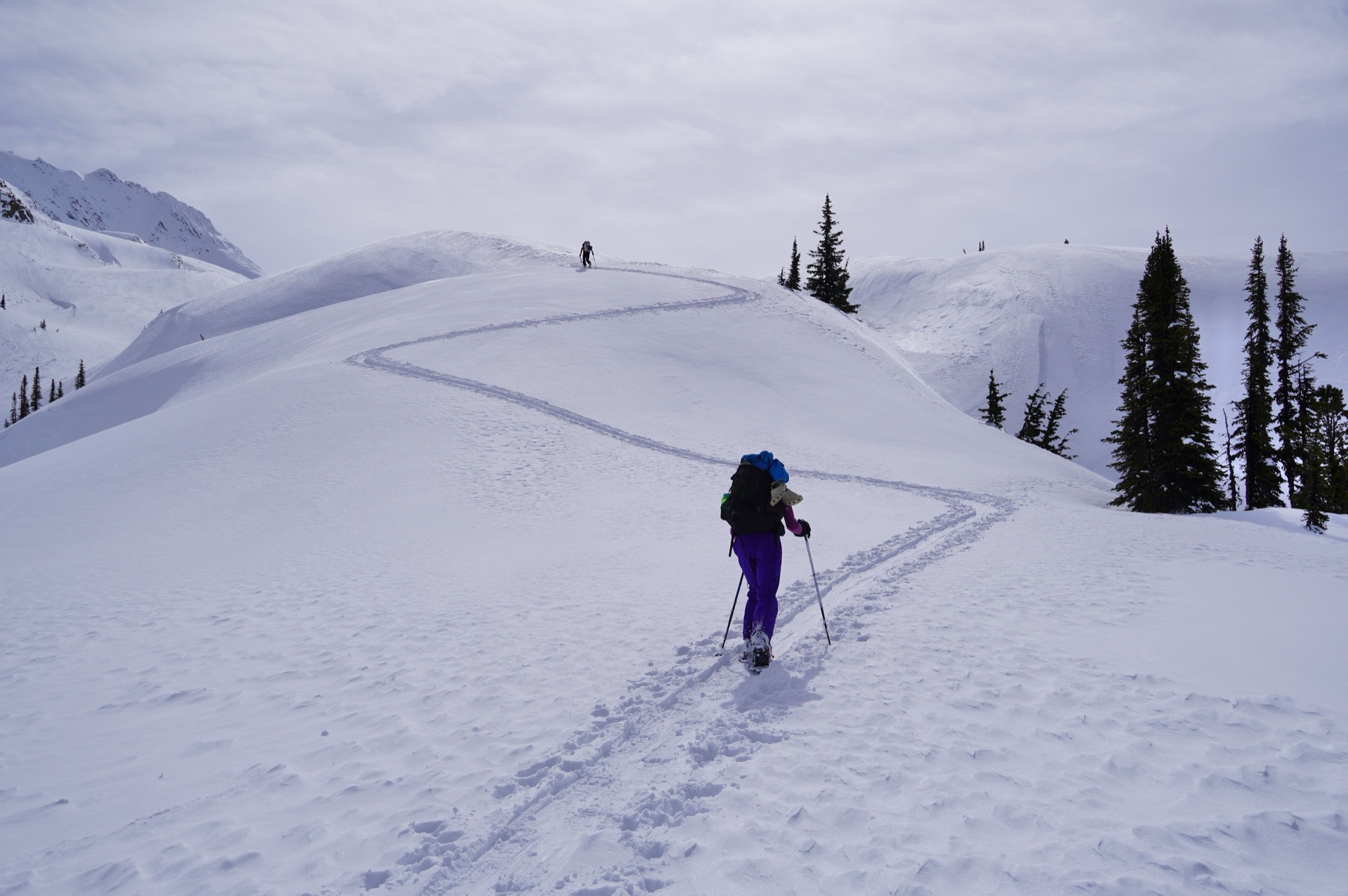 Snowshoes to the rescue! Ascending the final pitch to the hut.
After lunch, a subsection of the group skins up towards Young’s Peak.
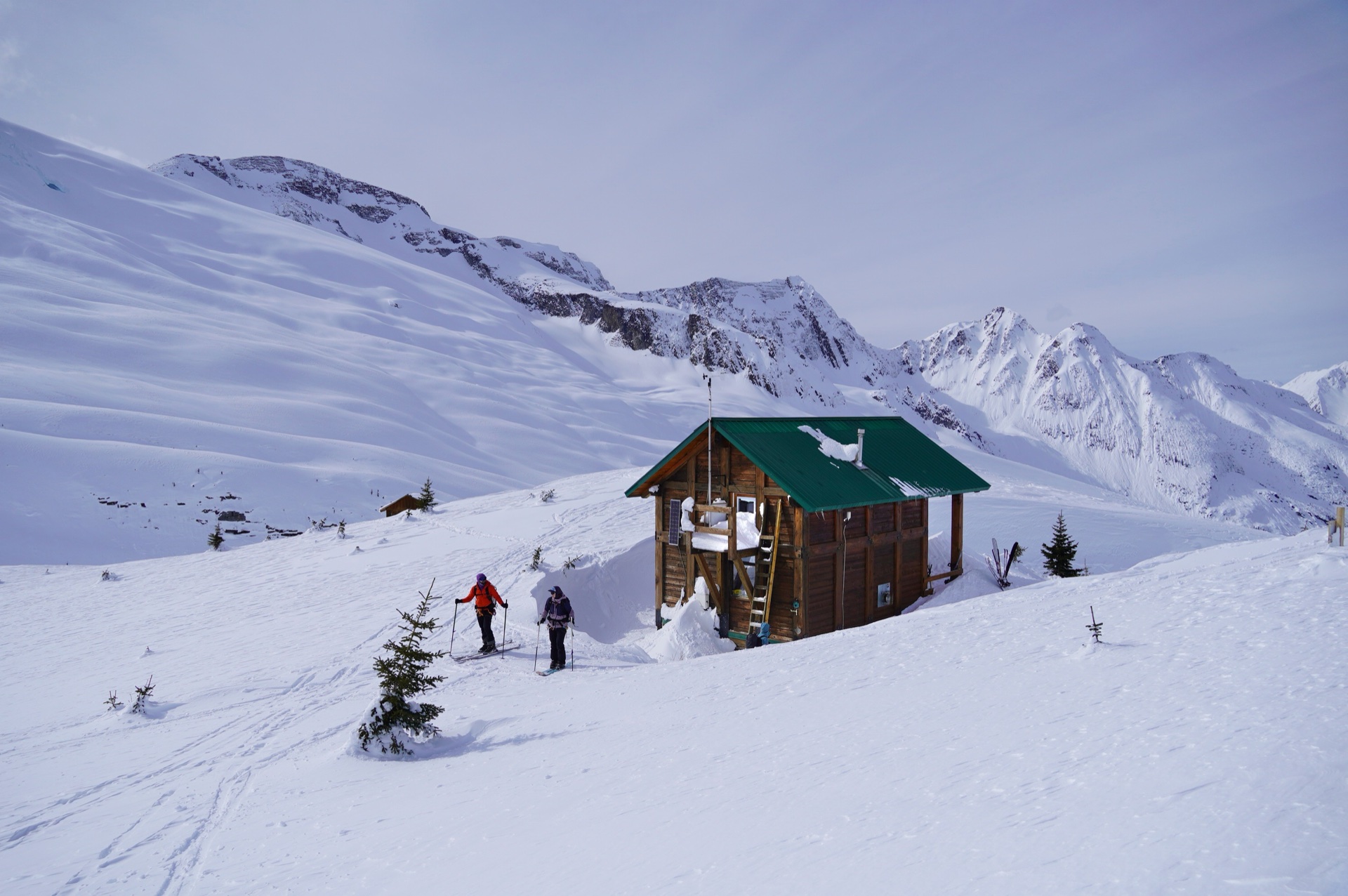 A cozy hut on a very windy ridge.
The wind is blowing quite hard and the snow is a little wind-crusted, but we have very clear views which we know are temporary.
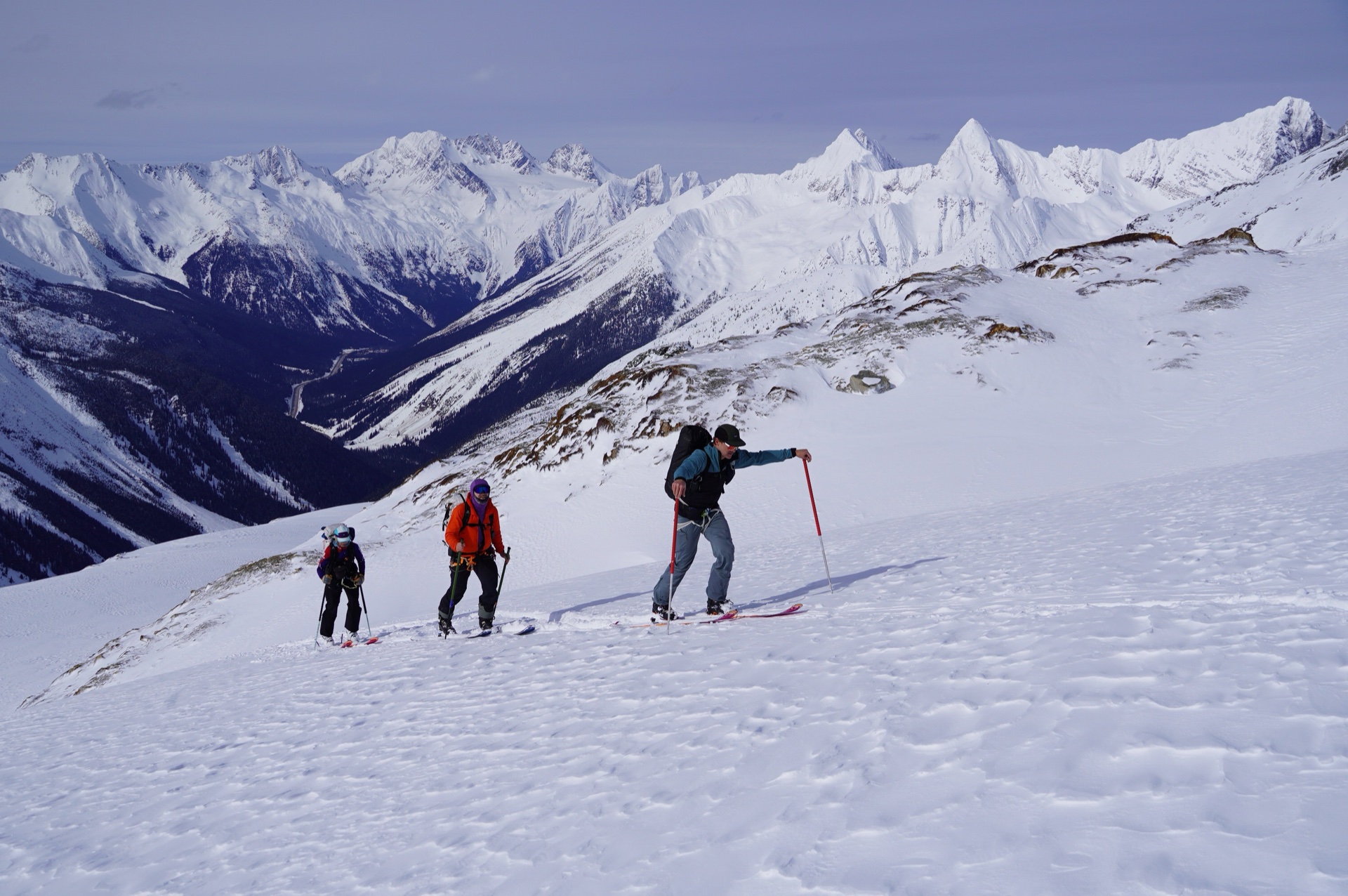 Climb to Young’s.
We skin up to the final pitch of Young’s Peak and wait for this large, disorganized group above us to drop before we begin our descent. This group had been skinning up towards the hut around the same time as us and we are already skeptical about their vibe after they abandoned one of their buddies on a somewhat wind-loaded slope near the hut. As we wait a large chunk of cornice falls and slides down the slope, crossing the skin track near the base of the climb. Did those guys just cut a cornice? Their buddy is still only halfway up the skin track. We are perplexed.
The disorganized group eventually drops; making slow turns right beneath the cornice that just fell. Who are these guys? The majority of their group pauses near us, but the fellow on the uptrack still has not moved. Is your friend going to drop? “We hope so,” they say. Did you guys cut that cornice while he was beneath you? “No”, they say, “not us”. We are only half convinced. Eventually their buddy skis down and Catherine, Sam, and Kyle begin the climb up towards Young’s Peak. I dislike how stacked the tracks are and elect to stay below.
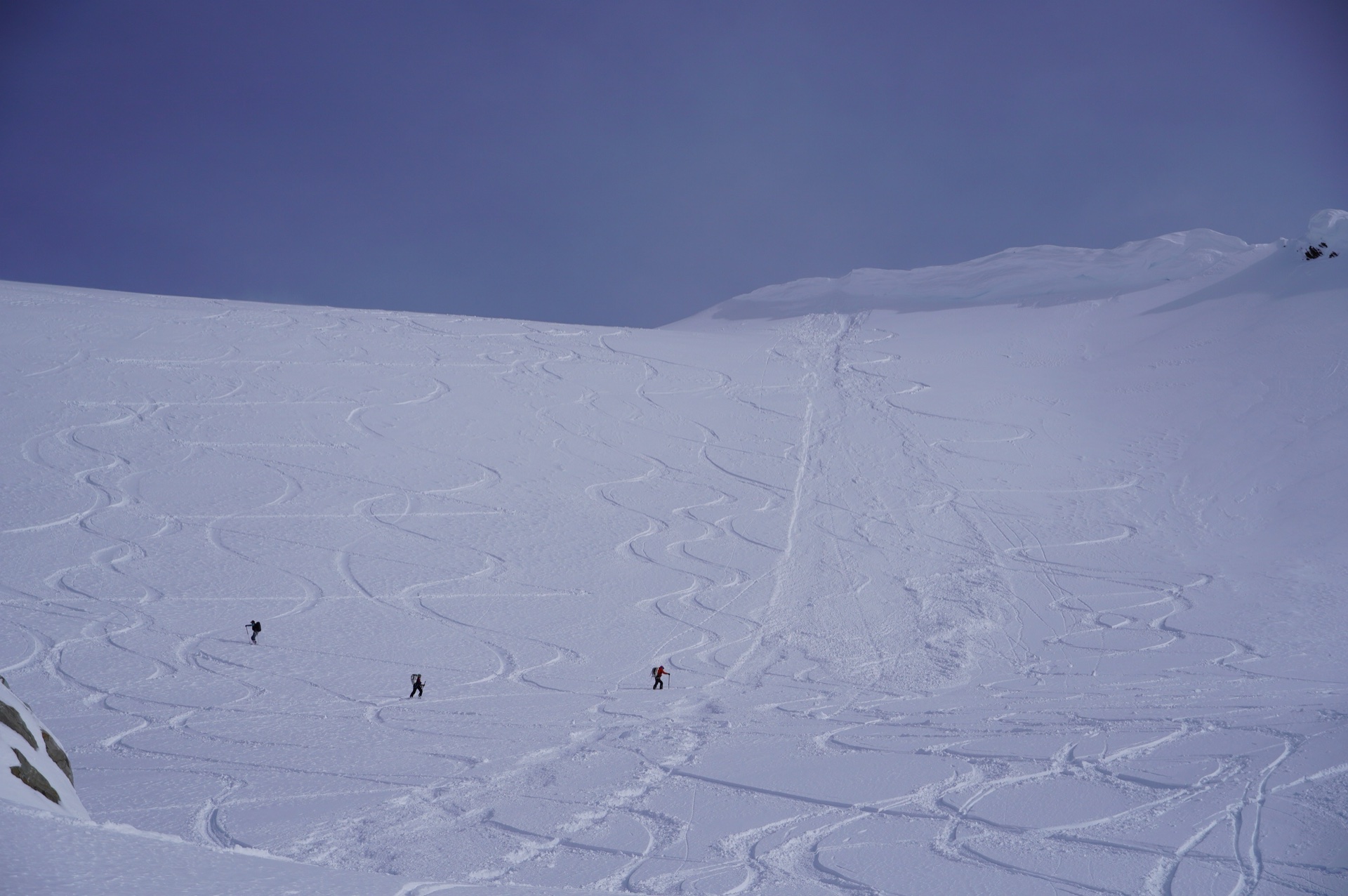 Sam, Kyle, and Catherine skin up the final pitch to the summit of Younge’s.
They make it up to the ridge and ski back towards me before we all point our skis downhill and slide back to the hut.
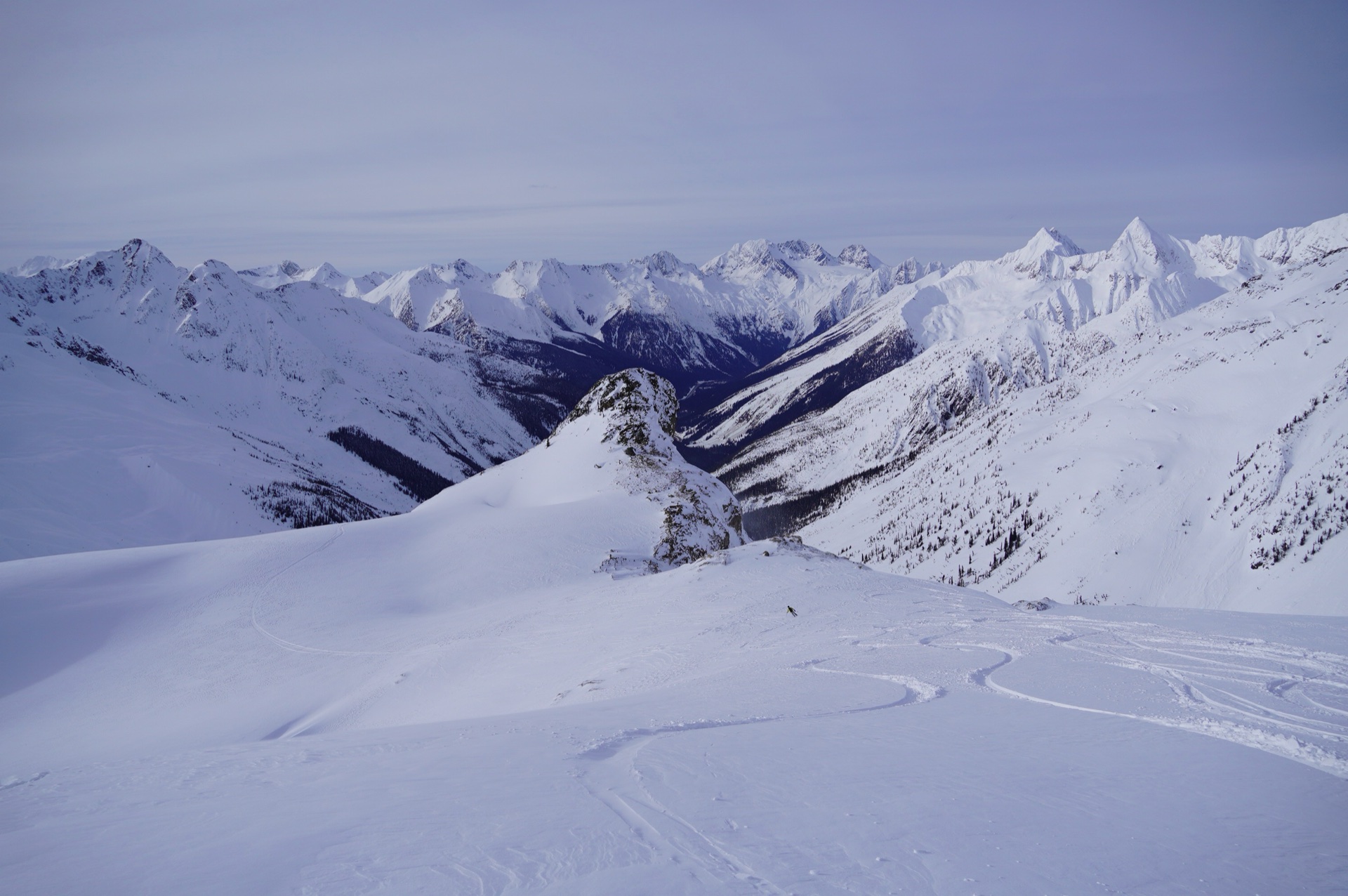 Looking back towards Rogers Pass.
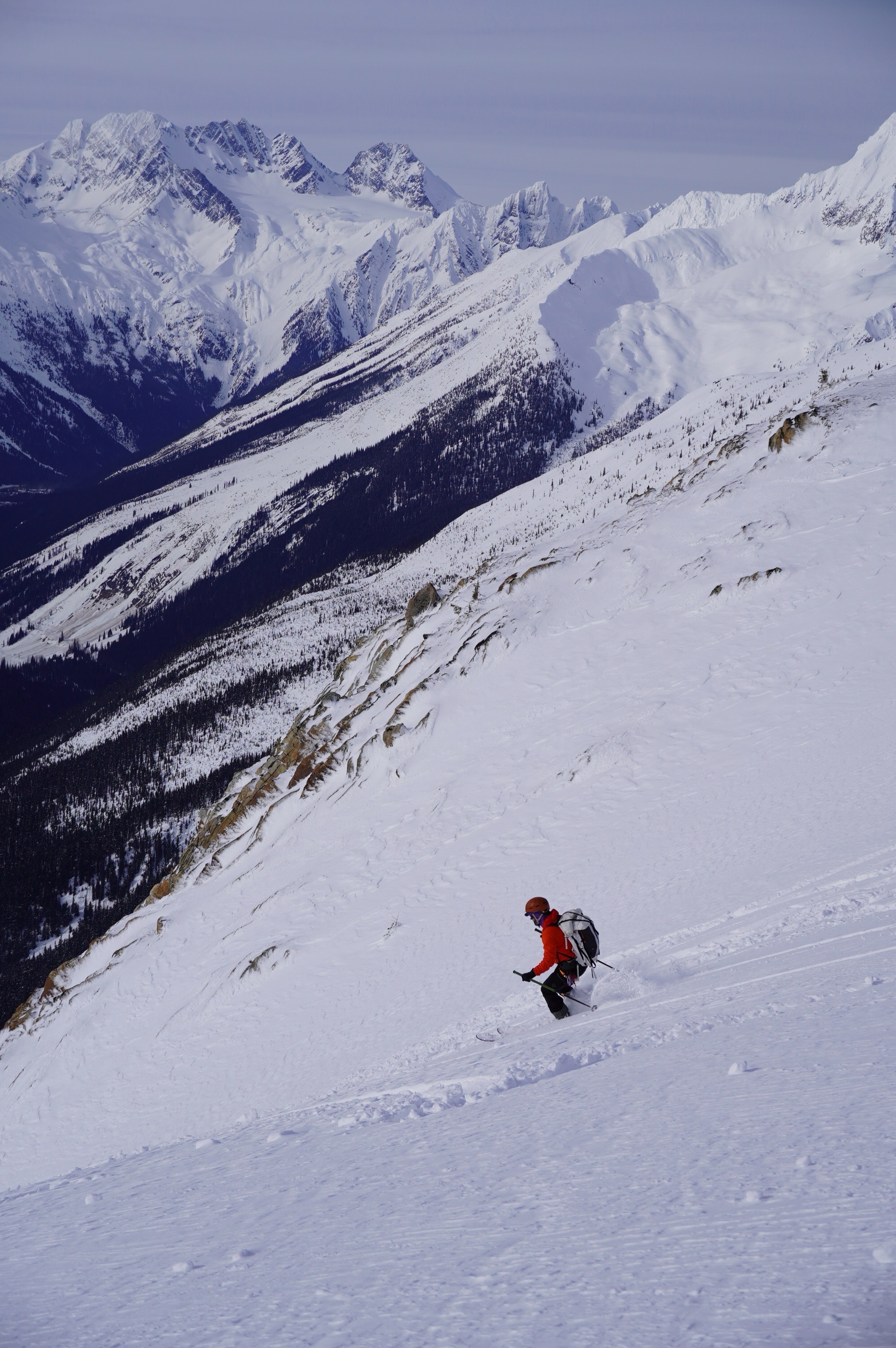 Sam dropping the slope below the Pterodactyl.
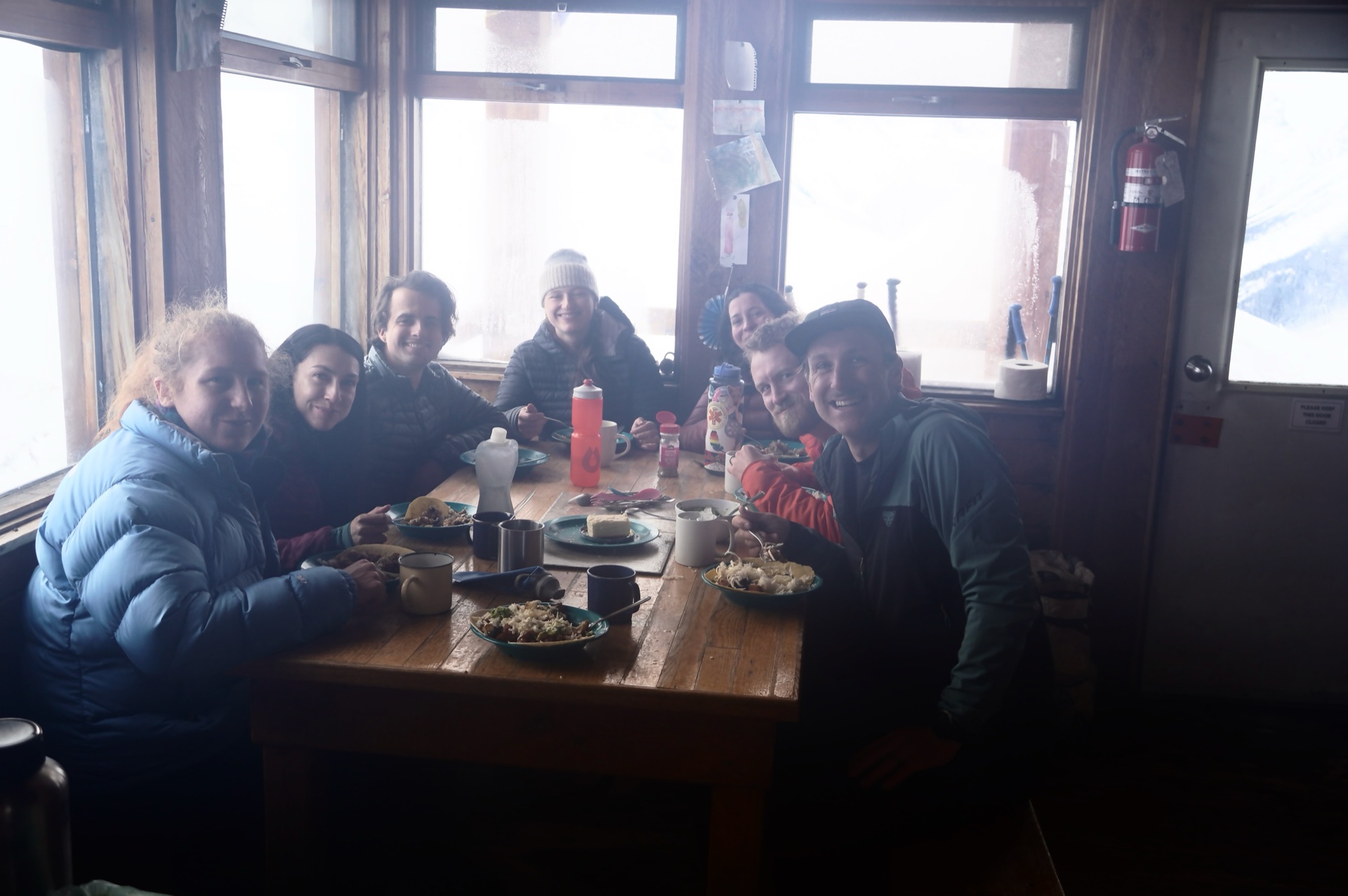 One of my few group hut photos, taken with a foggy lens.
Day 2: Storm Day
Day dawns with zero visibility and whipping winds. As the first bathroom user of our group, it is my responsibility to dig the bathroom out. This morning, that is a significant job. I try to cut out better steps down to the bathroom although with all the wind I suspect my work will not be long lasting.
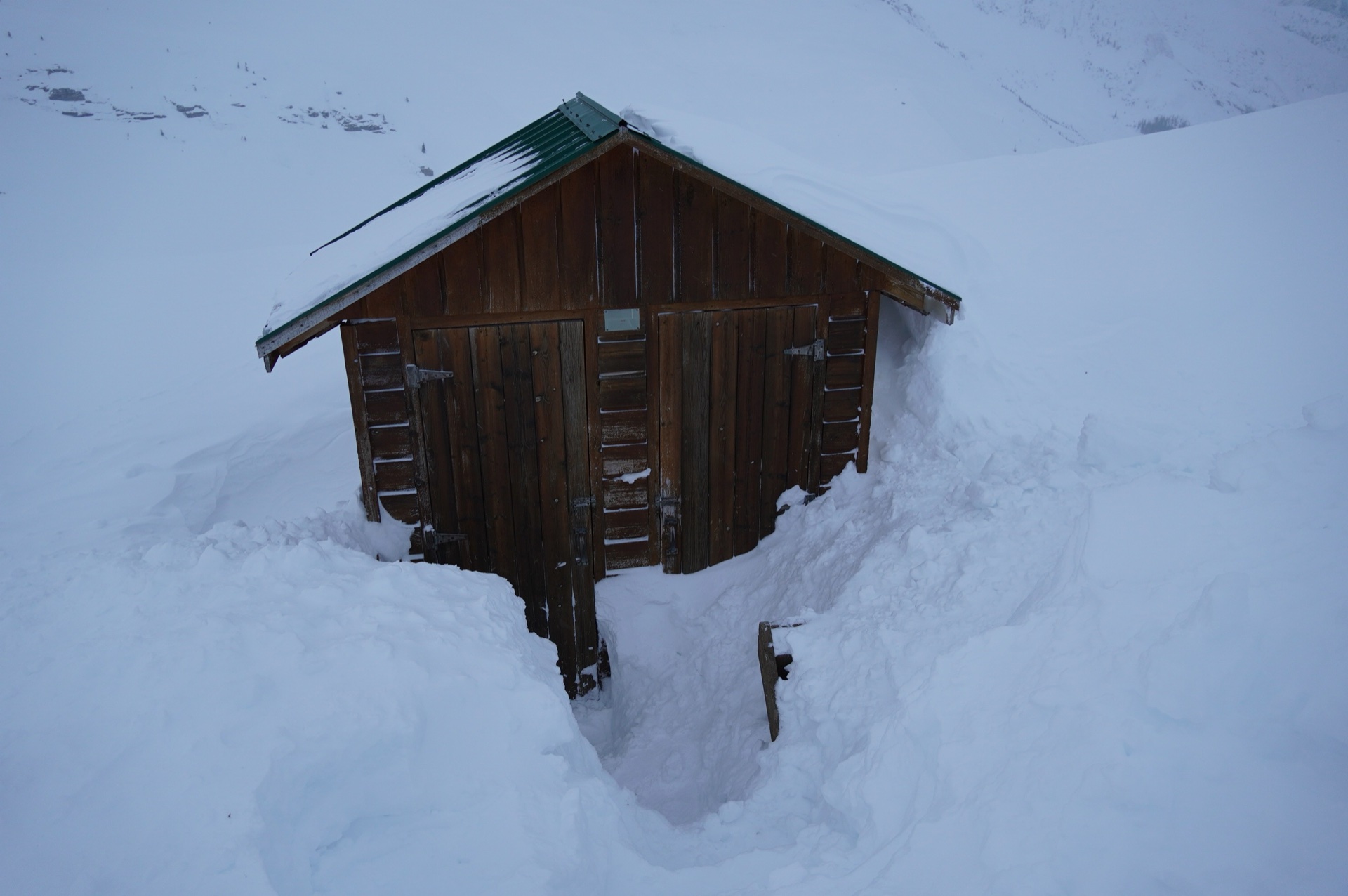 Steps carved by a modern day Michelangelo.
No one has big ski ambitions today, so we eat a leisurely breakfast then everyone pursues their own interests — Sam, Deirdre, Thomas, and I play a long game of hearts. We only stop when Thomas makes it to -50 points. The next closest player (Sam) has 0 points. I have 34. Thomas is a very modest card player. Throughout the game he points out his success has been due to random good fortune. However, by the end of 15 hands he has shot the moon twice and consistently scored lower than the rest of us.
At lunch we discover the two burner propane stoves are well suited to quesadillas.
In the afternoon Kyle and I decided to get out just to avoid cabin fever. We skin up about 800 feet above the hut. The ground has variable amounts of snow — in some spots there are 30 cm of wind-drift powder, in other spots the fresh snow has mostly been blown off the underlying crust. Kyle leads the way on our ski down and I am happy to have him below me for perspective.
After we get back, Mary and I also get out for a little ski. We only climb maybe 300 feet and then start skiing back to the hut. There is no visibility and at one point I get off to the steeper side of the ridge we have been skiing on and kick off a small windslab below me. It breaks maybe 30 feet wide and 20cm deep or so. A good reminder to be careful. We move back towards the crest of the ridge. Interestingly, on Caltopo the side of the ridge that slid displays no color. So in theory the terrain is on average less than 27 degrees. However, due to the lower resolution of Canadian lidar data (compared to the states) I suspect that the local feature we were on was briefly steeper than 30 degrees and too small to be captured by the lidar data.
We make it back to the hut and eat a shrimp pasta dish for dinner, wash up, play a game of Avalon (a trip favorite), and go to bed. The wind is really howling tonight.
Day 3: Tree Triangle Day
The snow continues overnight. I again am the first one to walk to the toilet, so I re-build my snow steps which had largely disappeared. Mary and I eat a quick breakfast and then walk around the hut on our skis. The visibility above the hut is quite poor, so I think it might be worth seeing the terrain down in the trees. However, as we slide down the ridge a cloud moves in and we lose what little visibility we had. “I don’t like this, let’s go back,” Mary says. And so we do. We get back to the hut right as the rest of the crew is prepping for a tree lap. I decide to join them.
We are a little nervous about a possible windslab on the steep part of the ridge. We ski it in turns and don’t set anything off. There is about 20-30 cm of fresh snow on top of the crust from the rain the previous week and as a result the tree skiing is quite good.
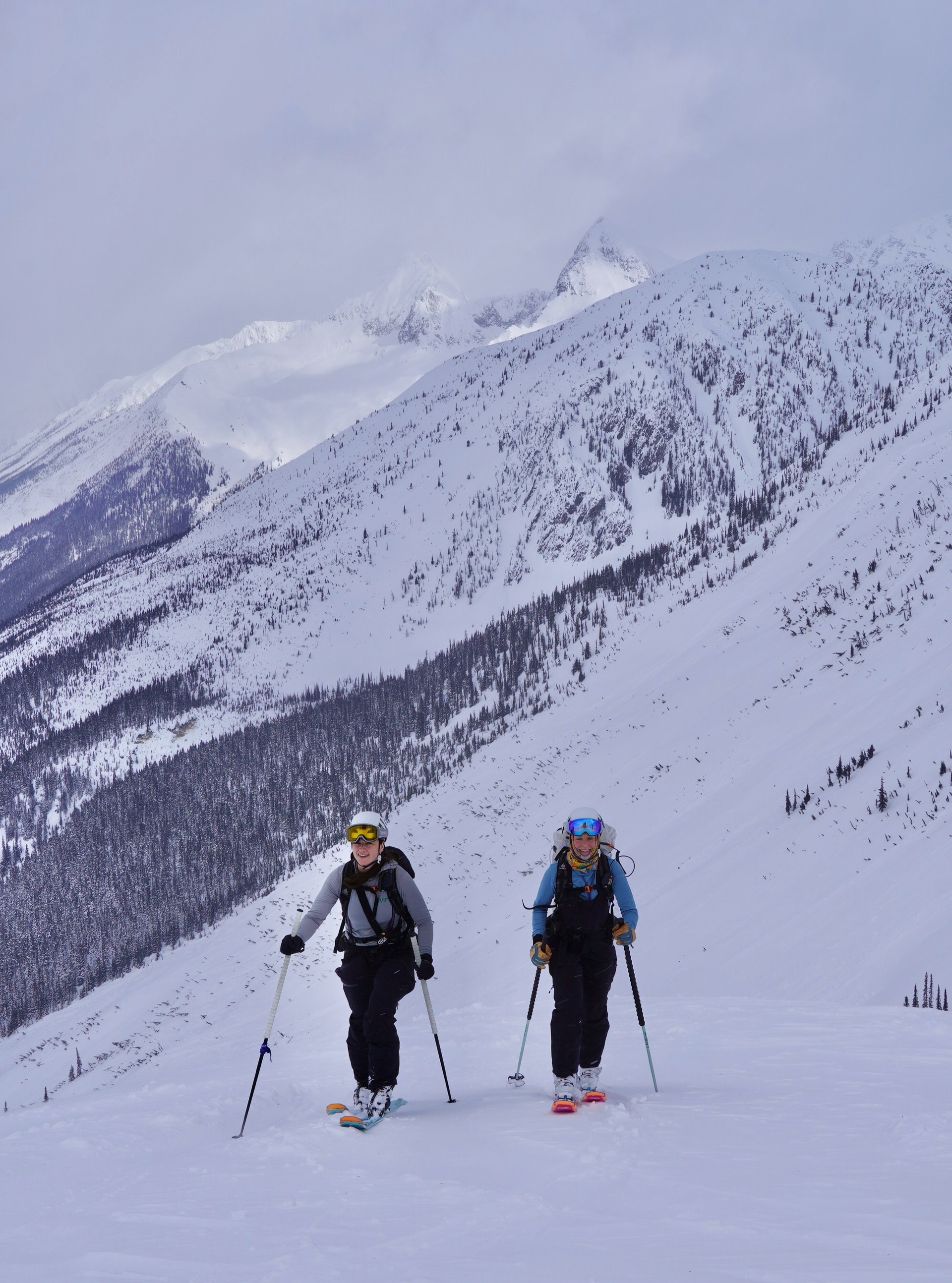 Deirdre and Catherine skin up for lap number two.
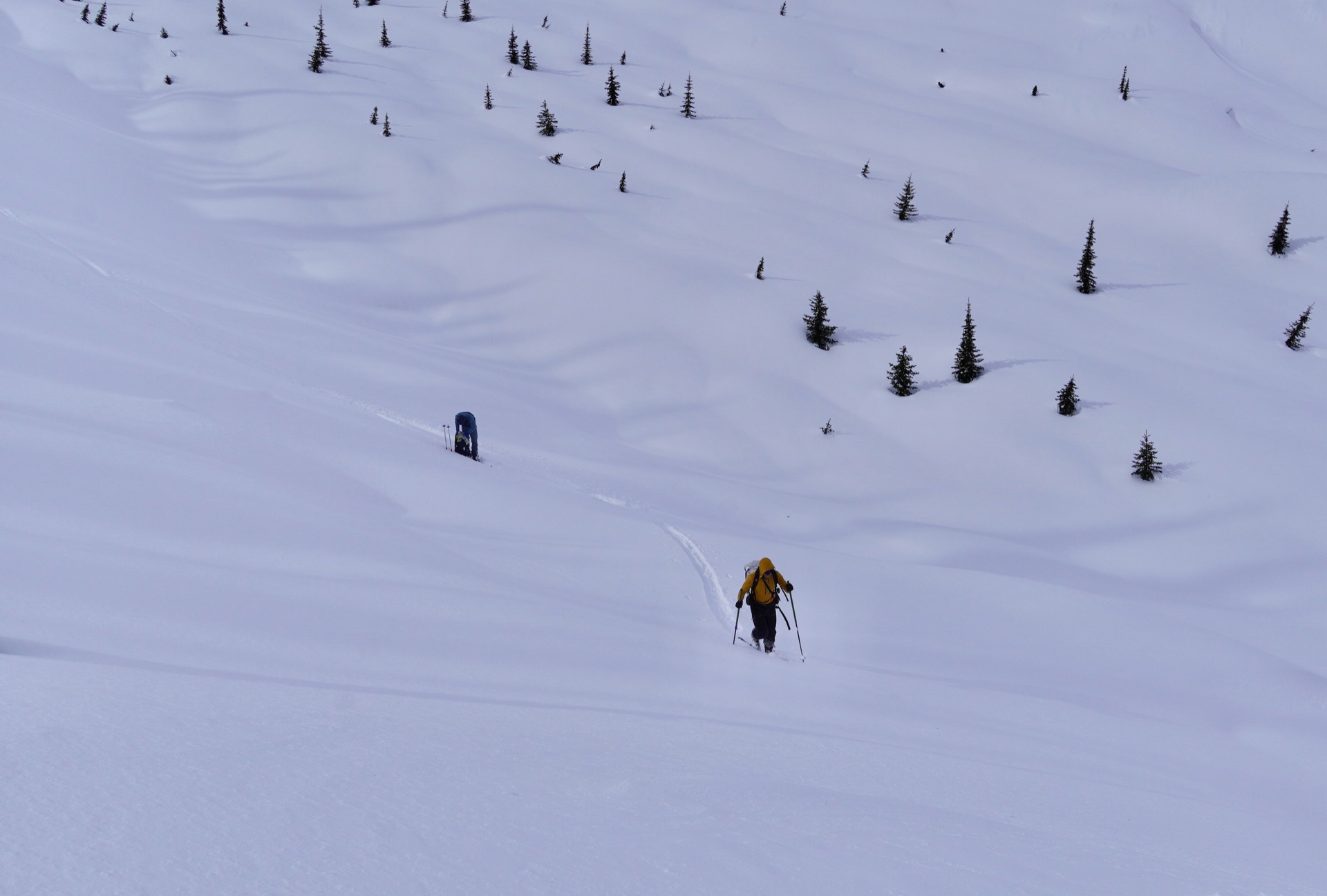 Sam cuts a skin track after transitioning below me.
We have two lovely laps and then I ski back to the hut to see if Mary might want to get out again.
I make it back to the hut to find Mary asleep. She is not especially stoked on the idea of getting outside, so I sit on the bed and wonder whether I should have skied another lap with the crew. We start to make lunch, which takes my mind off skiing.
After lunch Mary and I go out for a couple turns in the tree triangle. Skiing down the steeper slope Mary decides she would prefer snowshoes. We switch to snowshoes and then back to the skis and Mary makes some nice turns in the trees. We then ski a slightly steeper pitch until the trees feel too tight and we transition.
On the ski up, Mary is having difficulty maintaining traction on a steeper part of the skin track. I try to assist by going behind her, but only manage to trip her up and have a front row seat as she topples backwards into the snow. Not so nice. We decide to try snowshoes again.
Snowshoes get us back up the steep pitch and we pause under a tree to collect ourselves before walking back to the hut.
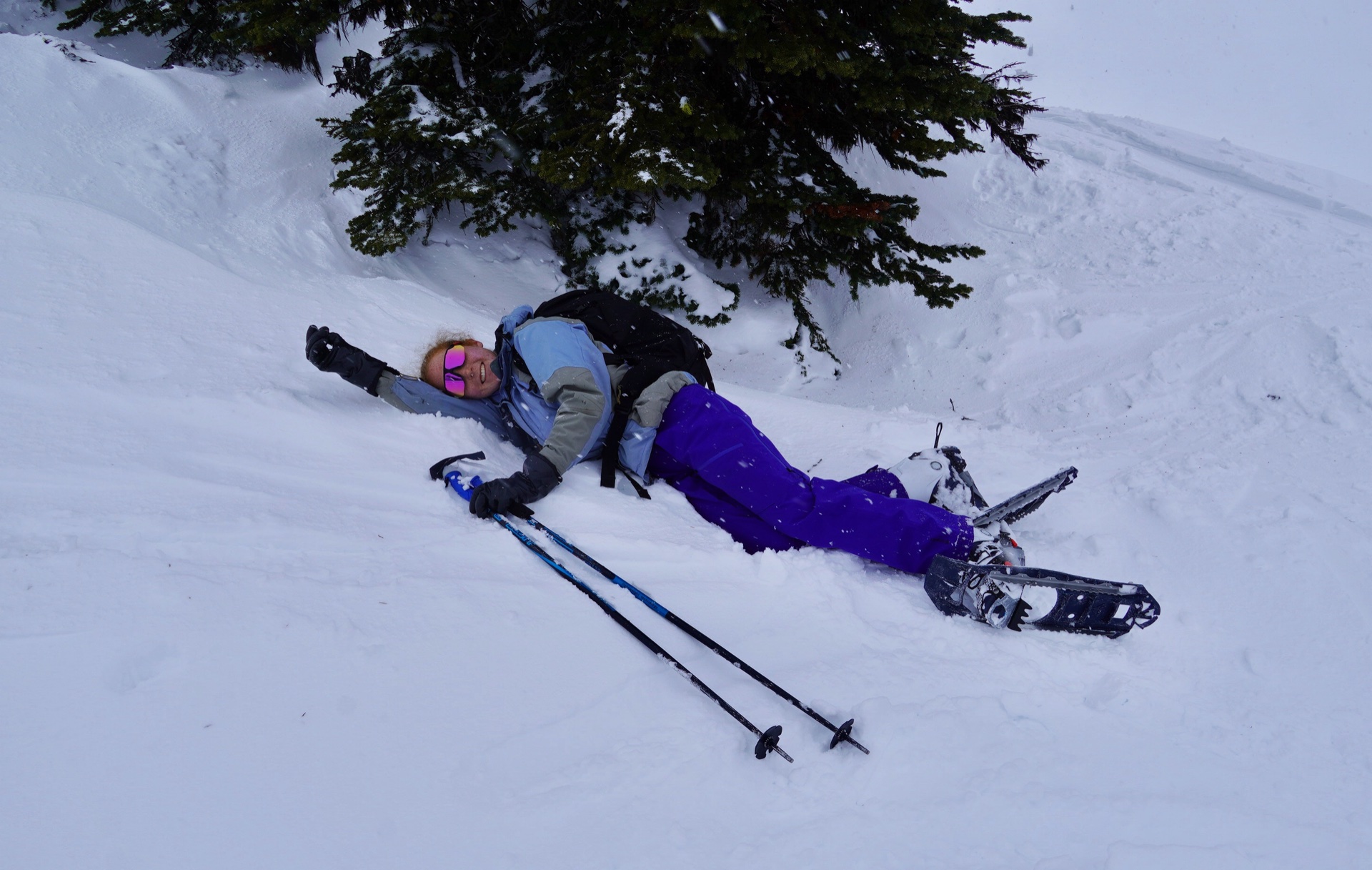 A quick break.
As we sit there Sam and Deirdre come by. I take a nice photo of them which becomes one of my favorite photos of the trip.
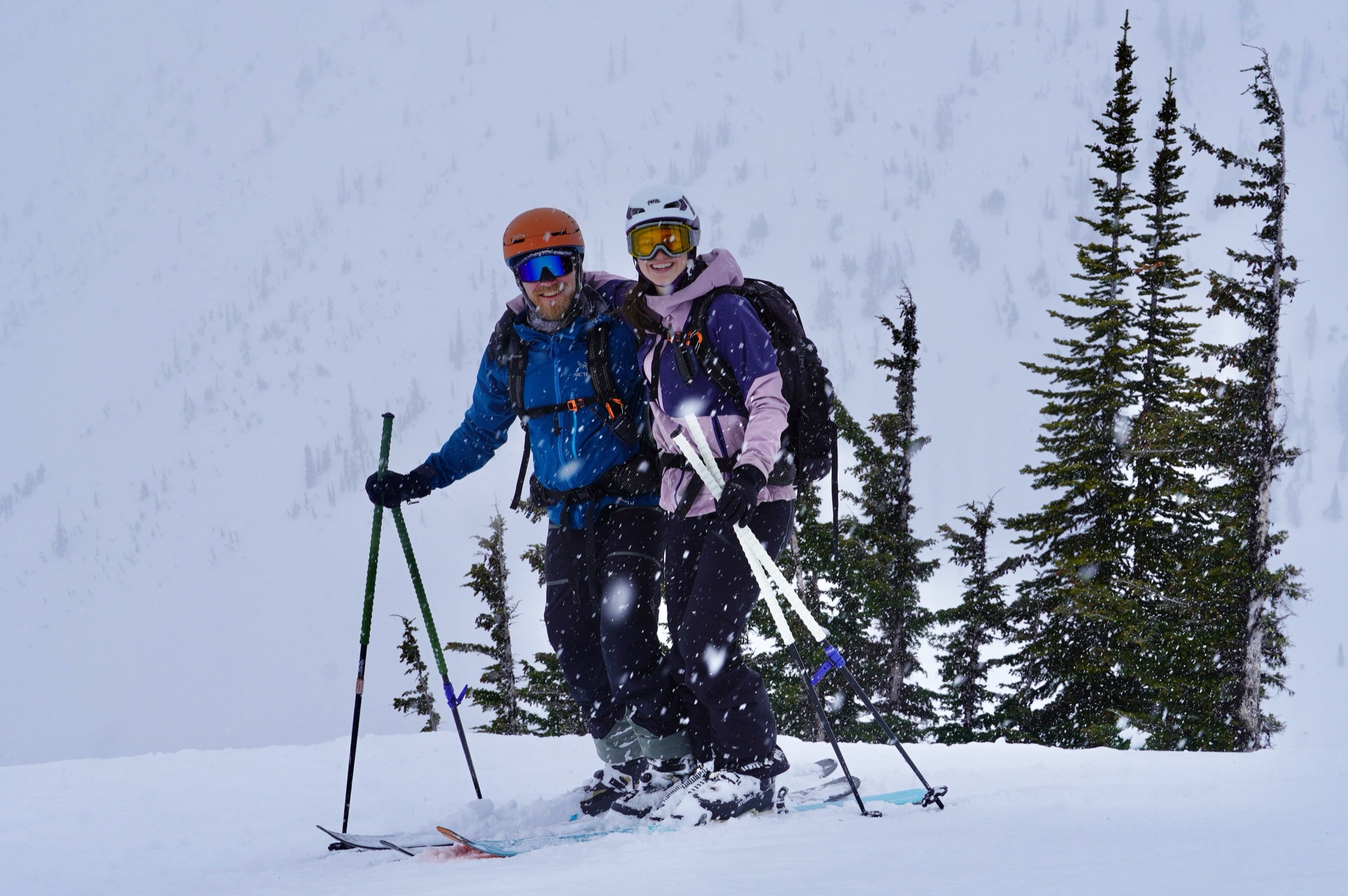 Mawwidge brings us together today…
We eventually start to cool off and stroll back to the hut. At this point it is snowing in earnest and we have very little visibility. Fortunately, we are going uphill so it matters less.
We make it back to the hut. Mary kindly suggests I go ski a lap with Sam, which I do. And then as Sam and I are climbing back to the hut I get a radio from Thomas and join him for a lap as well. Happy days.
That night we eat Sam’s chicken curry. It turns out 2.4 kgs of chicken, 1.1kg of rice, and six cans of coconut milk is more than the eight of us want to consume. Sam’s dinner is the only dinner with a surplus of the main course. Well done, Sam, well done. In admiration, I volunteer to bury his surplus chicken curry in the snow to keep it refrigerated for consumption the next day.
After dinner, we light the propane lanterns and play another round of Avalon. Games like Avalon are very rewarding because the feedback loop between making mistakes and improving is reasonably tight.
We go to bed dreaming of perfect visibility and blower powder.
Day 4: More tree triangle
The day starts with my customary excavation of the toilet. Following that, the whole group eats another leisurely breakfast. The visibility is still poor enough that no one is in a rush. However, as we eat the visibility seems to be improving. After breakfast Mary and I get our gear on and start skinning above the hut. The sun is almost peeking through. The light is still a little flat and the contours of the terrain above the hut are visible for the first time in two days.
As we skin up it looks like the sun might come out for a moment and I even catch a photo of our friends below us in what looks suspiciously like sunlight.
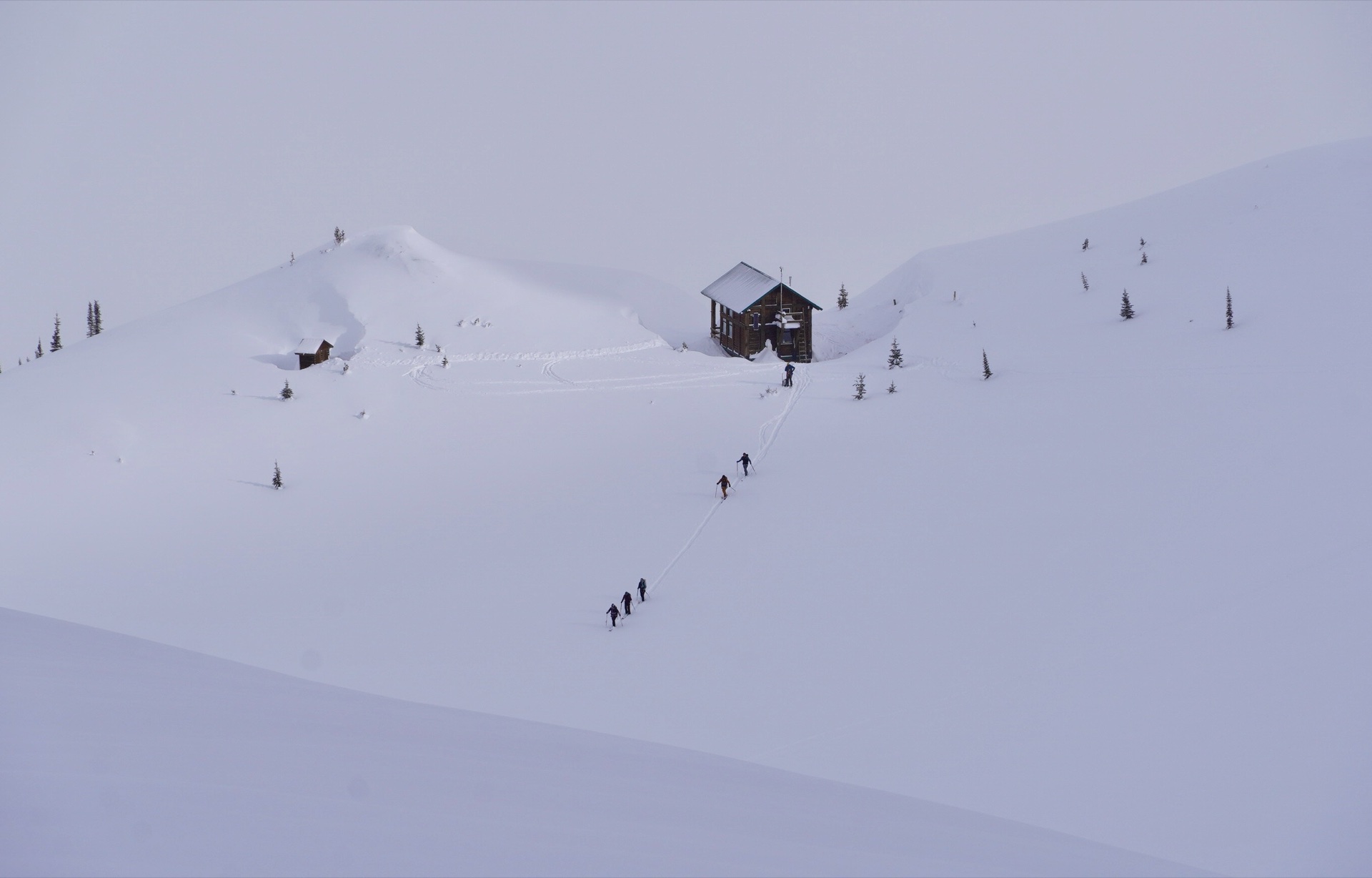 Bluebird?
However, the moment passes and the clouds begin to again occlude any blue in the sky. Rather than bet on the weather improving, Mary and I rip skins and ski back towards the hut with decent visibility.
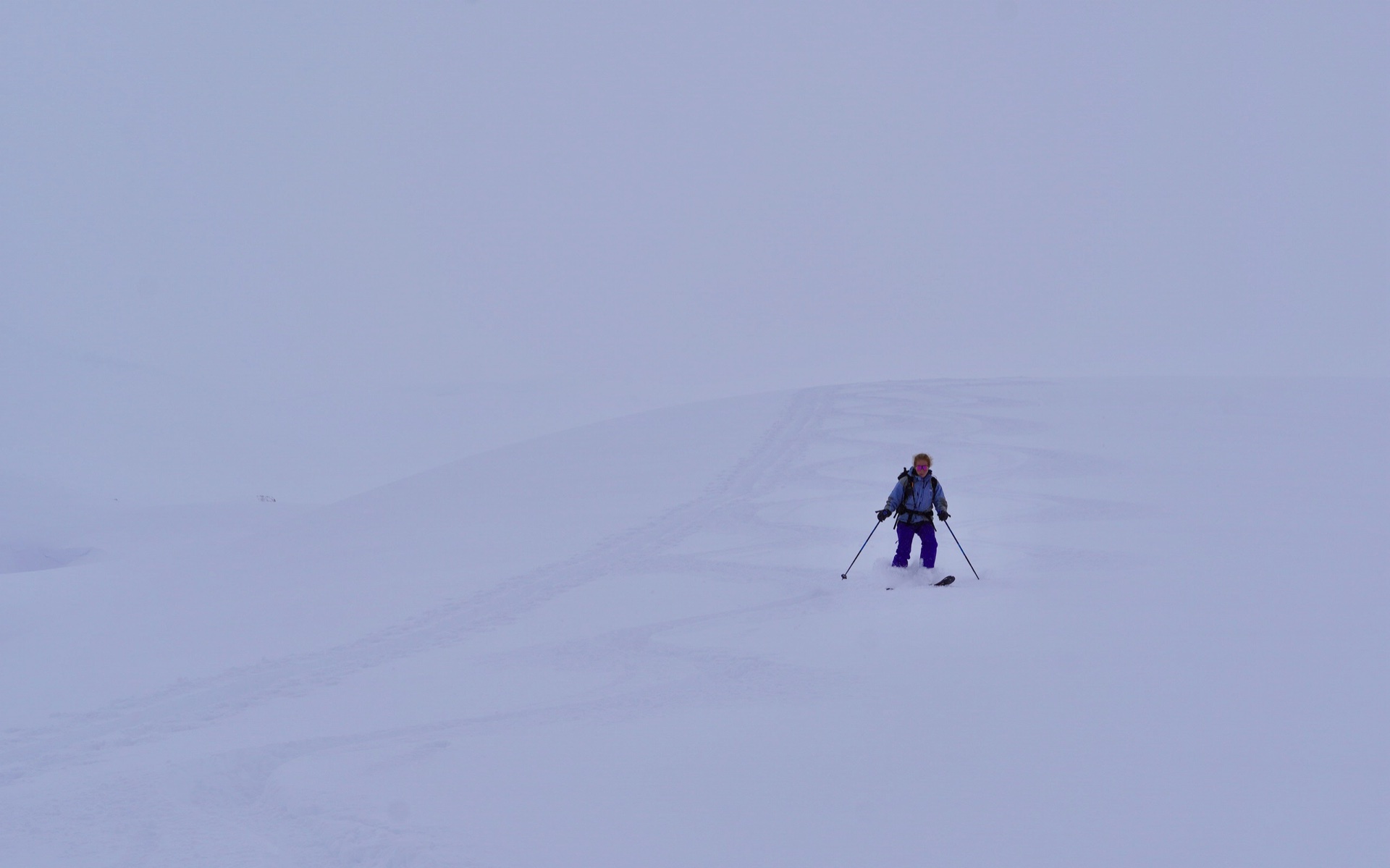 Skiing close to our uptrack to help with depth perception.
Upon making it back to the flats near the hut we decide to go up for another go. As we climb the visibility decreases and the snow starts again in earnest. We rip skins near the same spot as before and ski slowly back down to the hut. It is a modest two ~400ft runs but I am very excited that Mary has been able to ski some Canadian powder with at least passable visibility.
The rest of our crew makes it back shortly after we do. We enjoy watching them from the window make the somewhat challenging final ~10m climb after finishing their descent, short enough that it seems like one can do it without skins but long enough that it is a bit arduous without traction.
With the snow falling, we decide some tree triangle laps are in order and ski two before returning for lunch.
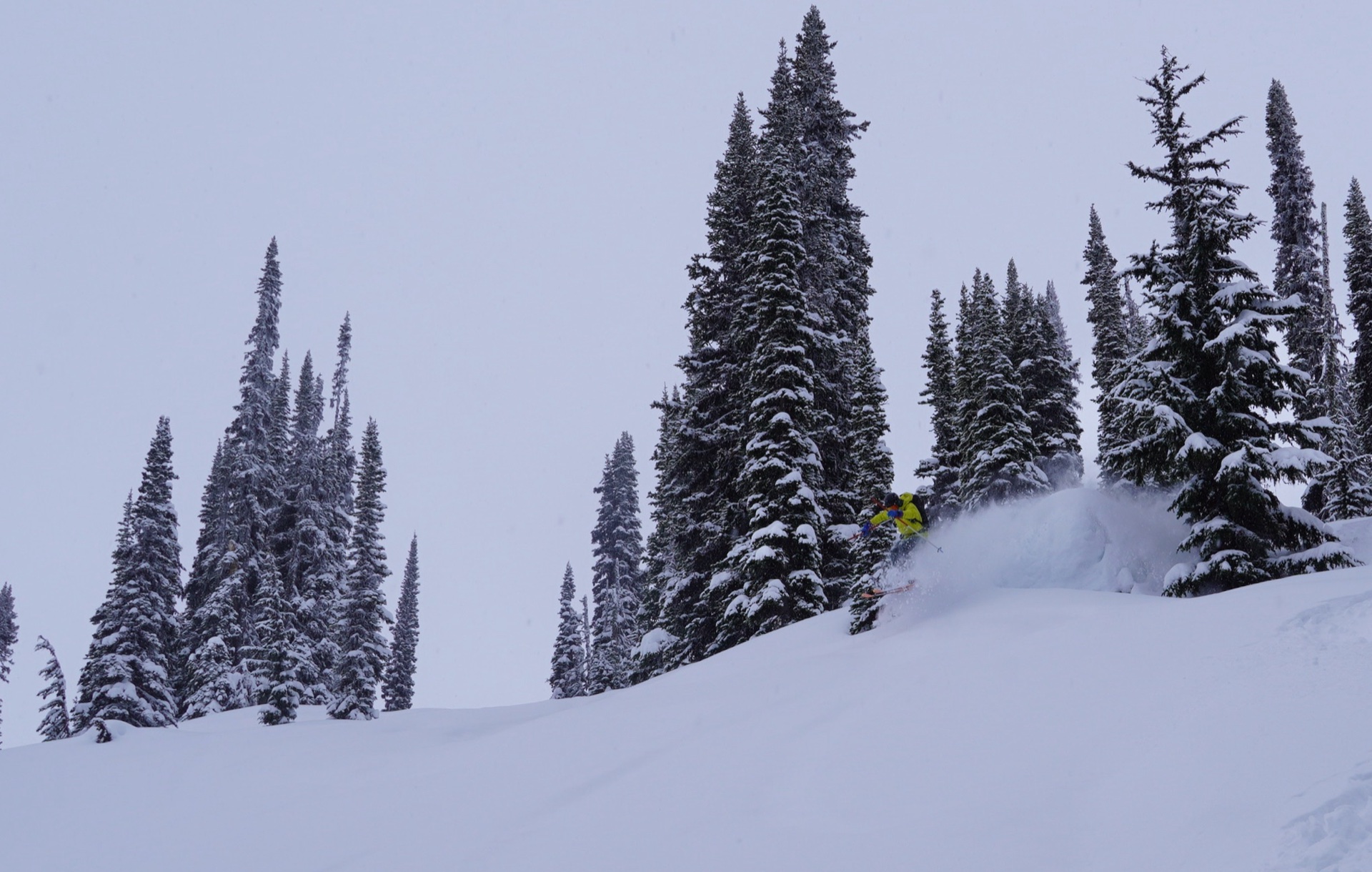 Pillow line?
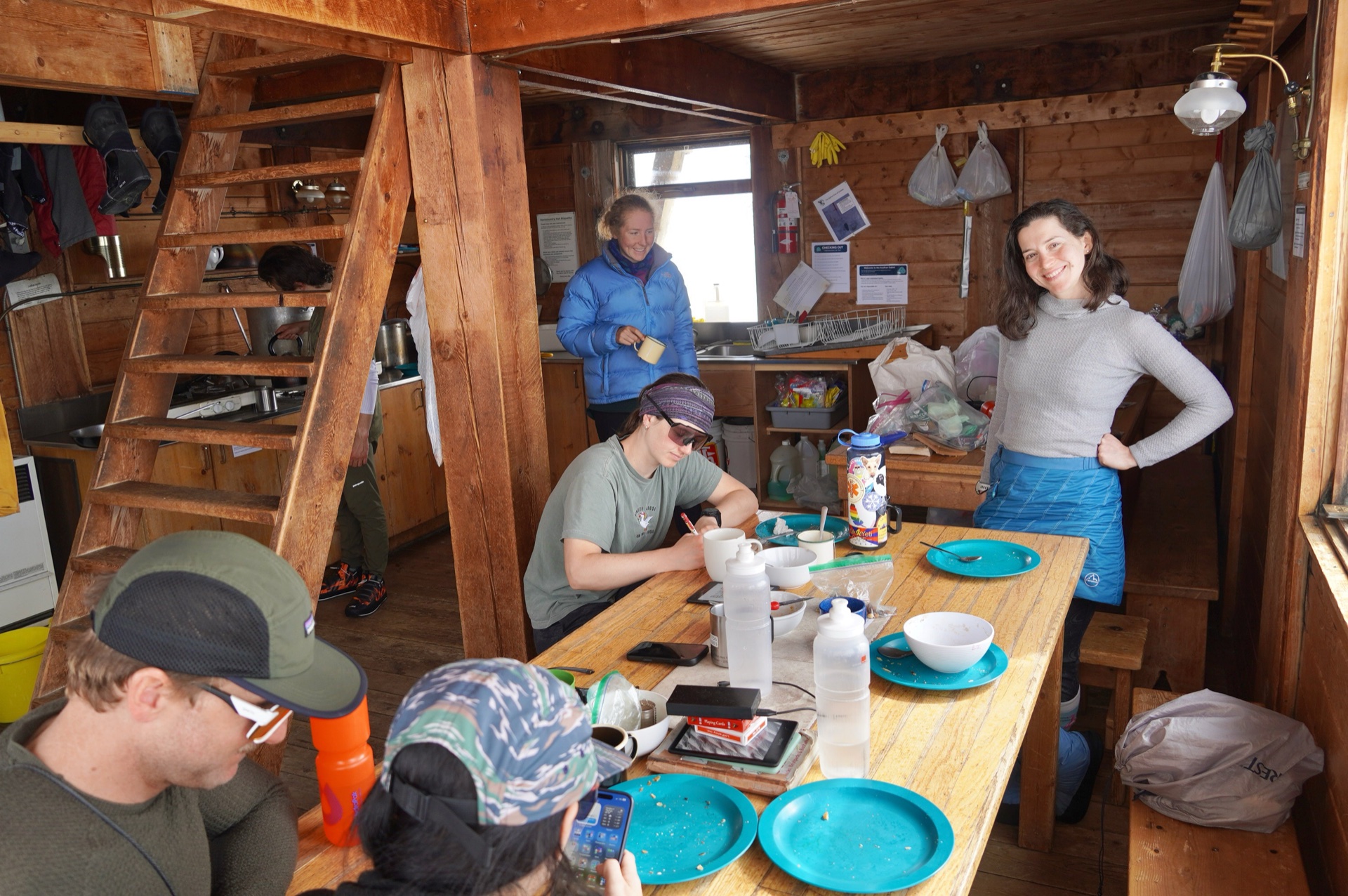 Lunch!
Snow is falling at an impressive rate still after lunch, so a number of us go for another tree triangle lap. I then skin back to the hut with the hope of getting out for a short lap with Mary. And so we do. The visibility clears a bit and Thomas, Mary, and I have three very pleasant short laps above the hut before we again lose visibility.
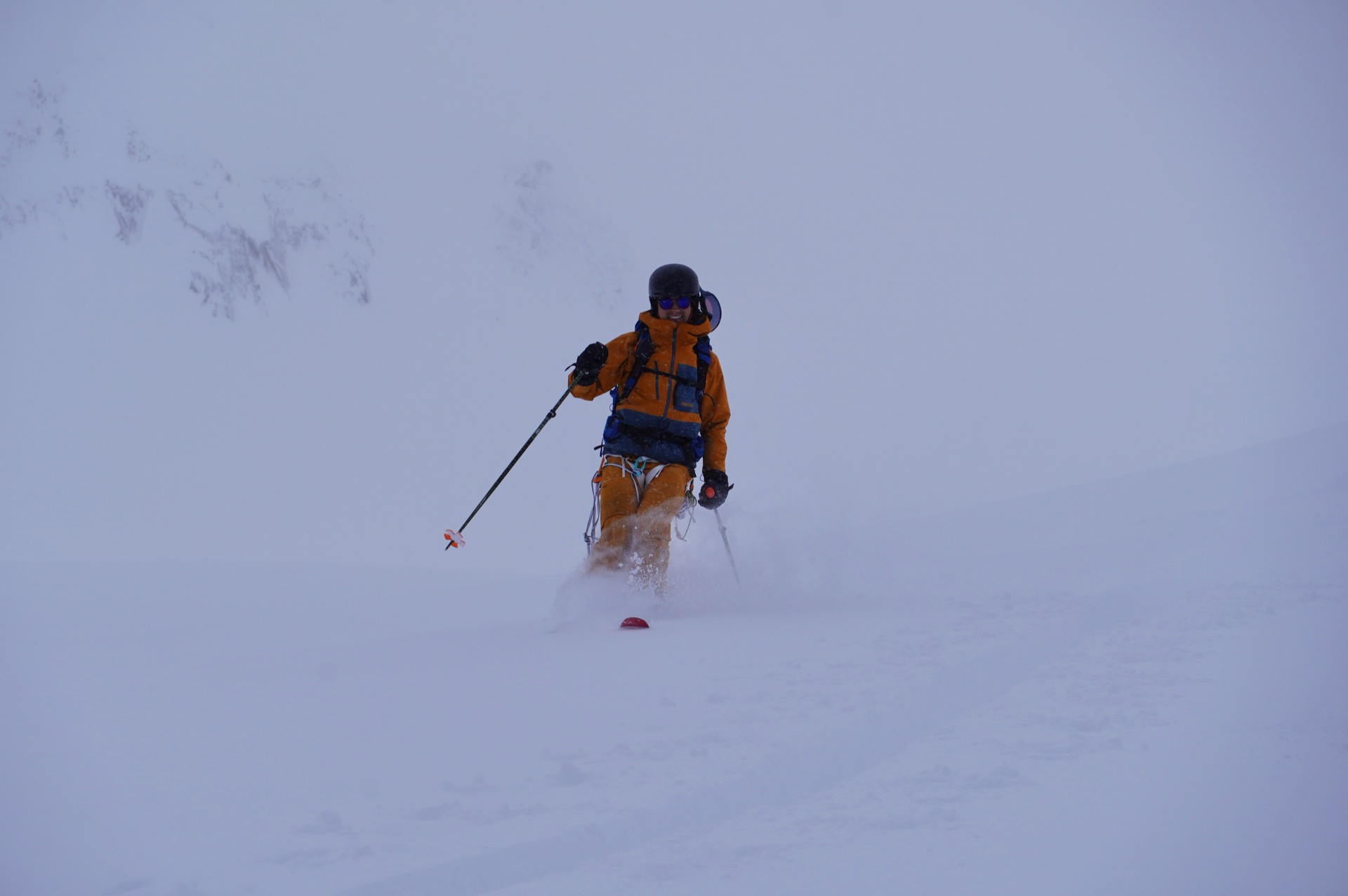 Tombo!
Day 5: Asulkan Pass and ski out
I go outside for a pee at 6:15 and blue skies are everywhere. Not wanting the rest of the group to miss it, I go back inside and annoyingly wake everyone with “Blue bird alert! Blue bird alert!” After setting the morning hut machine into slow movement, I make a beeline to the bathroom and dig the toilet out one more time.
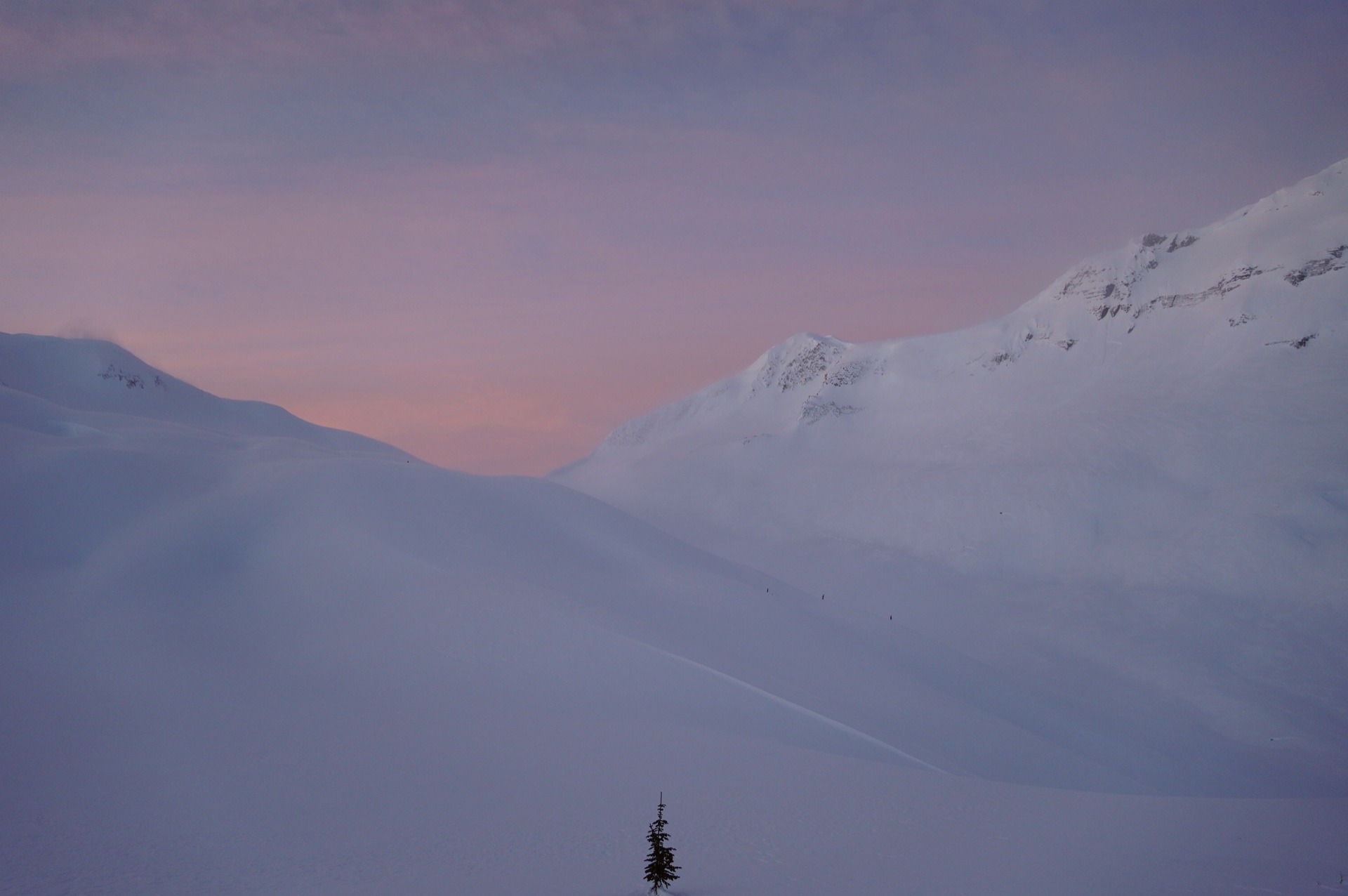 Looking up towards Asulkan Pass.
While the sky is blue, the wind is also whipping. We are rapidly disabused of any ideas about perfect powder unmolested by wind.
However, I am still stoked just to finally have some visibility above the tree line. Thomas, Mary, and I eat a reasonably quick breakfast and then begin skiing up the ridge.
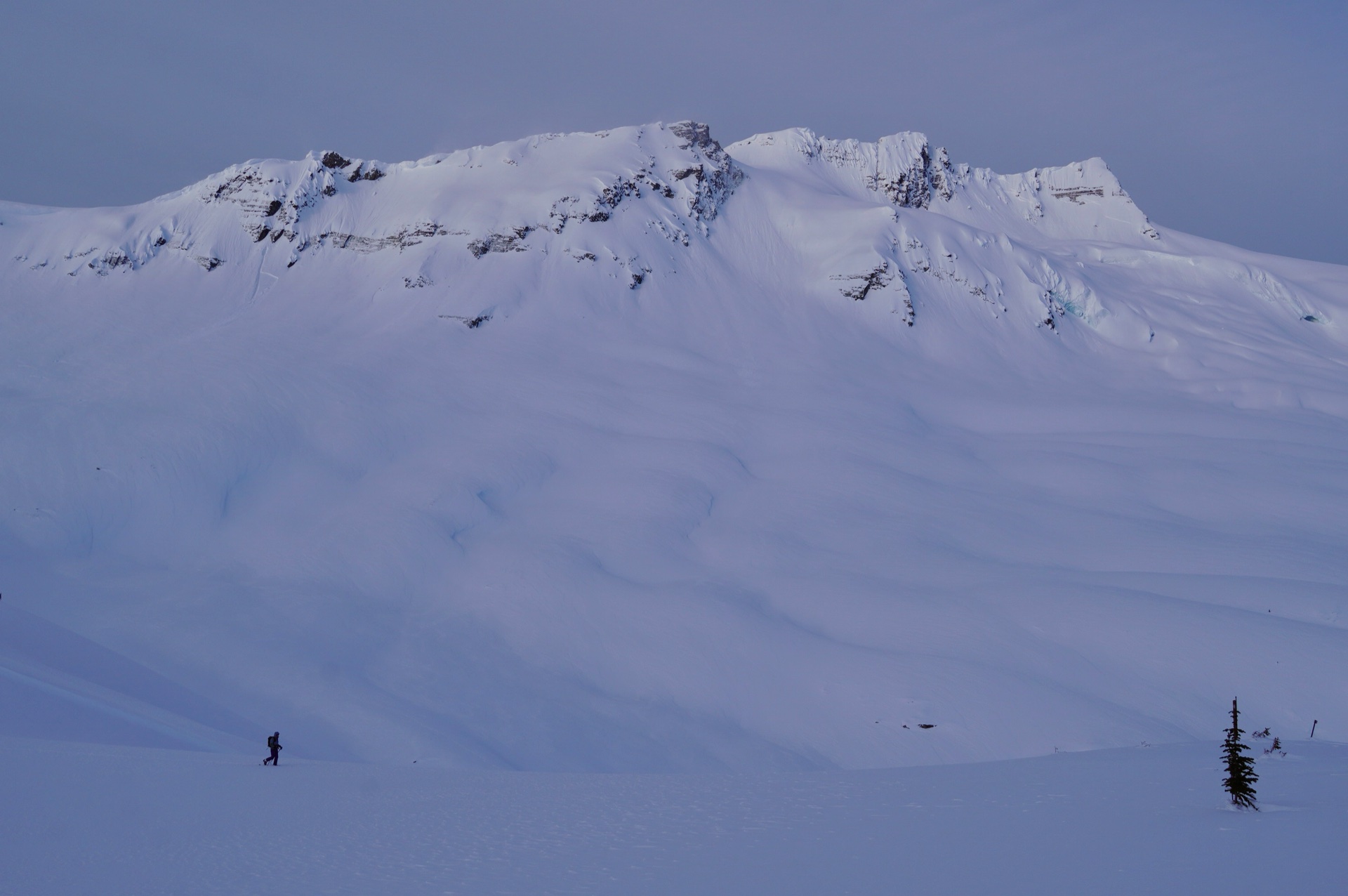 Mary is the first one out the door.
The visibility is certainly better than it had been the previous 3 days, but is still reasonably flat. Mary, aware that we still have a long ski out later in the day, makes it up to our previous high point of some rocks and skis back towards the hut. Thomas and I continue a long traverse up to Asulkan Pass. The whole climb to the pass is quite low angle. At times it is hard to tell whether the slopes we traverse are also low angle. Caltopo shows everything as sub 27 degrees but, wary of small terrain features, Thomas and I spread out as we climb to the pass.
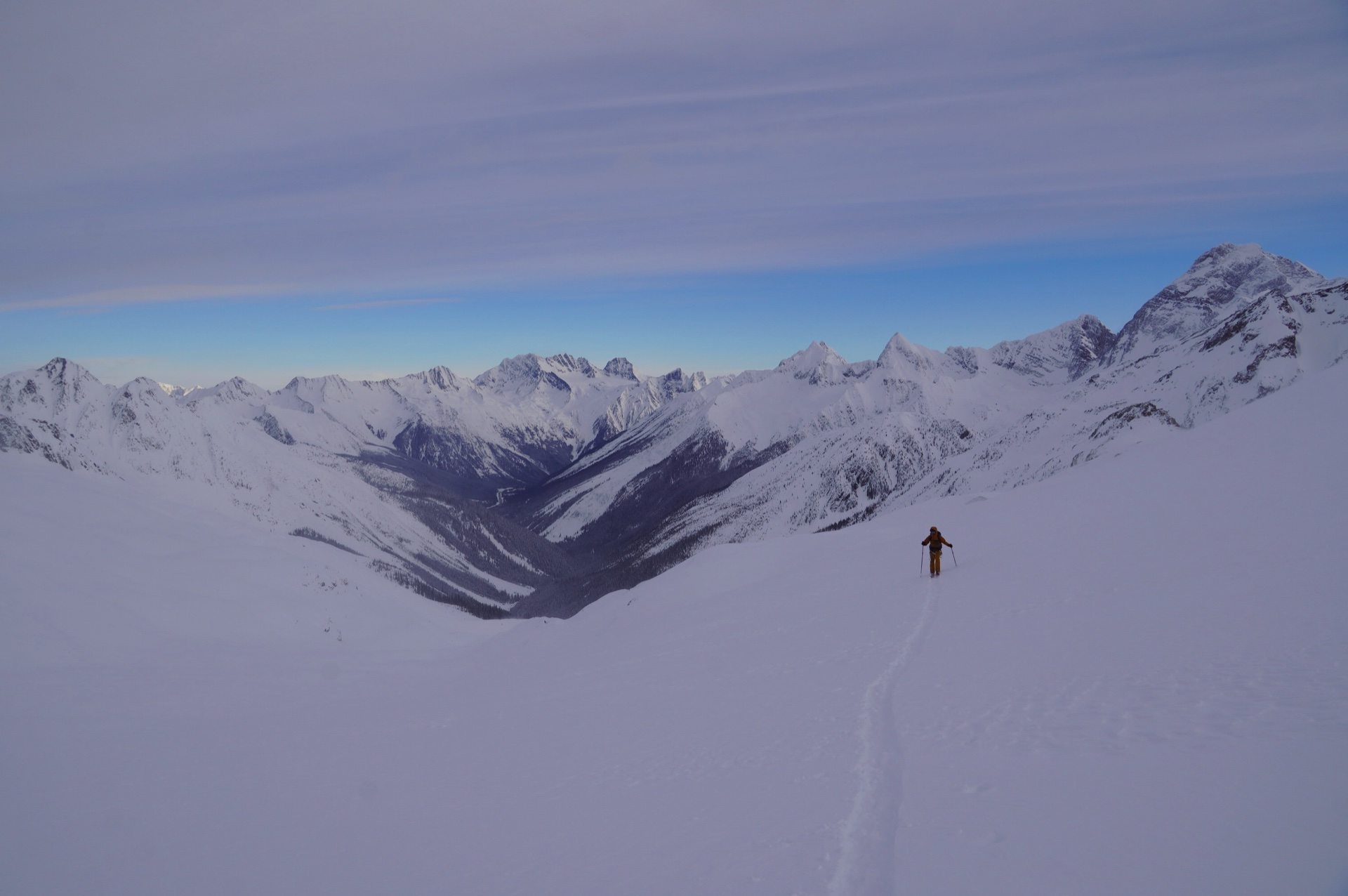 A long traverse to the pass.
Eventually we make it to the ridge and get a nice view towards Comstock Couloir. In theory the Bugs to Rogers traverse goes over this pass. With the wind whipping I am just as happy that my earlier aspirations of skiing the Bugs to Rogers traverse had stayed as aspirations.
We do not dally on the ridge. I cut a skin track back towards the base of Young’s Peak. We can see Sam’s group in the distance. They had started after us but are now above us as they head towards the base of Young’s Peak.
We cut a long traverse and end up one pitch below Sam’s group as they begin to drop.
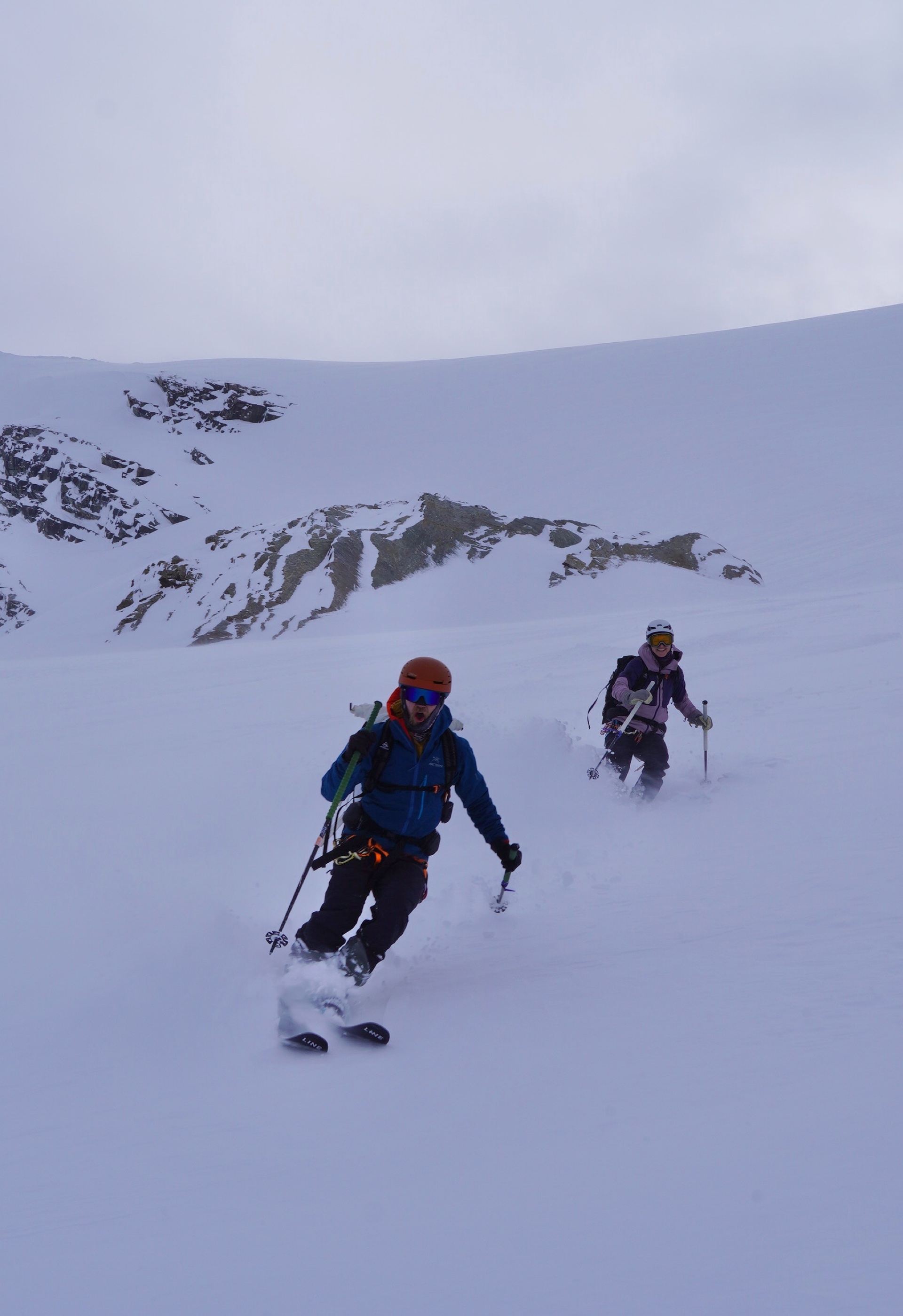 A whooping Sam.
We also ski up to the same point and Thomas and I rip skins and slide back to the hut. We make it back at 9:30 with the visibility significantly worse than when we departed.
After a bit of a snack, Mary and I start back towards the trailhead. We assume we will be slower than the rest of the group so get a head start. Mary does great as we ski down the tree triangle, keeping her skis on the whole time. I keep us skiing on the right side of the tree triangle, which I think might be a little more gentle than the left lines. That may or may not be true, but we are able to ski all the way down to the start of the avalanche debris. There we transition to boots and boot our way down the track that folks are skinning up. As we pass ascending day-trippers I apologize for destroying their skin track.
As we stroll down the avalanche debris, we hear over the radio some very suspect things from the rest of the group. It sounds like they are trying to stay high above the avalanche debris. However, from our angle, slopes on both sides of the valley look quite steep. Better them than us!
In good order, we make it off the avalanche debris and have a very pleasant glide and double pole back towards the creek.
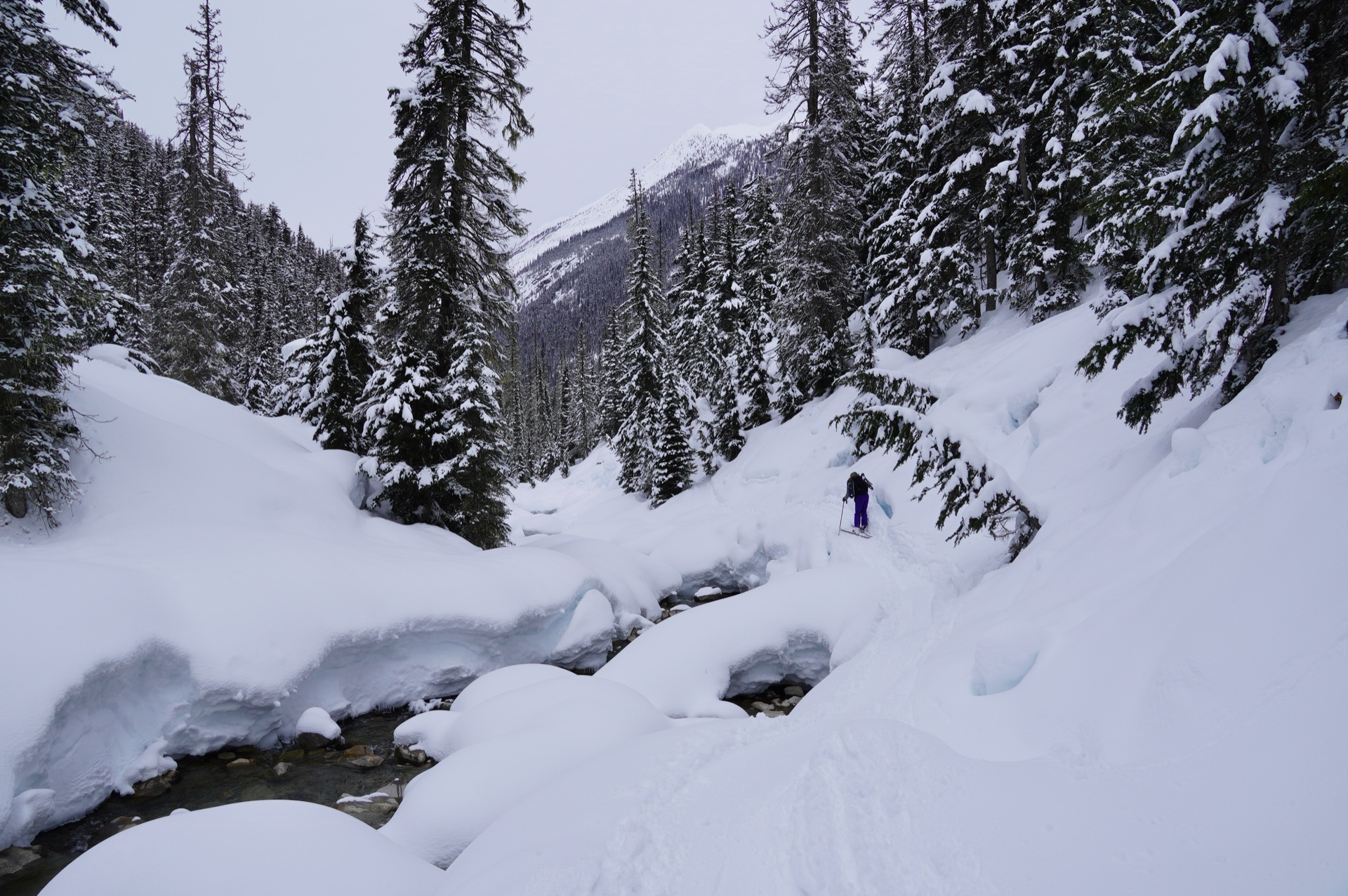 As they say, it’s easier going down.
Mary does excellently on the steep creek bit and we soon find ourselves back on the old railroad grade. We pause to chat with some guys heading up to Asulkan. When Sam had booked the hut he had noted that it was booked from Friday–Sunday even though those dates were more than 180 days prior to the date when we were booking. I ask — are you guys guided? (assuming that the guided groups might have an inside door). They are not. Are you guys associated with the ACC? They say they are members but not otherwise affiliated. I am prepared to drop it, but Mary bluntly asks how they managed to book the hut more than 180 days in advance. This more direct line of questioning is successful. “Ahh we know the guy that built the booking system,” says the first guy, a bit bashfully. He quickly points out that they are Canmore locals and still have to fight tooth and nail to book a hut. And I do not begrudge him his special privileges. If anything, I am mostly grateful that the Canadians are willing to allow us Californians to become members of the ACC and book huts at all.
The rest of the descent is uneventful and we get to the parking lot before the rest of the group. We clear about 15cm of snow off the cars. The rest of the group arrives and we take one group photo (minus me) and then drive to Golden for lunch.
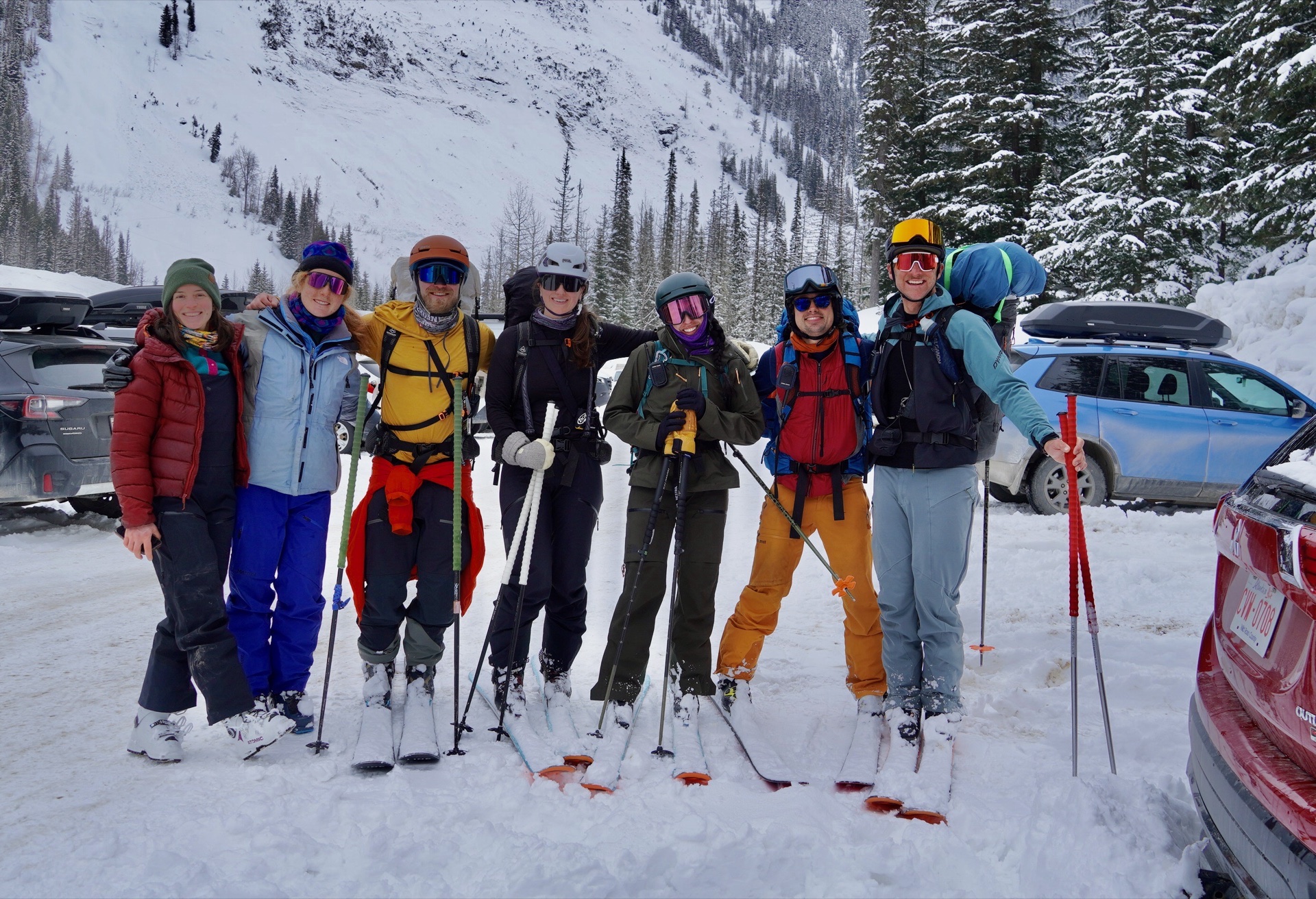 Successful trip!
Notes
- Kyle printed out the slope-angle shaded Caltopo of the area. That was a great idea. It’s very fun to look at the local slopes on a large piece of paper.
- In retrospect, it was nice to have one buffer day at the start of the trip before skiing in.
- New skis for Mary prior to this trip might have been warranted. Hers are slightly old and heavy (2100g per ski) and the bindings are a little more fickle than modern AT bindings.
- After skiing out, we skied a day on rented nordic skis at Dawn Mountain. Terrific experience. There was a scavenger hunt for little kids as we arrived and a volunteer appreciation day going on. The volunteers had surplus bratwursts and fed us.
- 6200g for dinner food for a group of 8 was about right. We probably carried about 200g extra of rice (packed 900g) and 200g extra of cheese (packed 600g). Otherwise I ate the whole meal.
- For Mary and me excluding dinners, we carried 6,350g of food for 4.5 days (on Monday, out Friday afternoon). We basically nailed it. Carried out 400g of cheese at the end and some bars. If Mary had been skiing bigger days we might have even under packed.
- Deirdre had miso soup and I was jealous.
- Ramen for midday snack is a nice way to get fluids + salt in.
- If Mary and I do a similar trip in the future, buy her down booties.
Leave a Comment
Your email address will not be published. Required fields are marked *